TTF(3AUG05)
Download script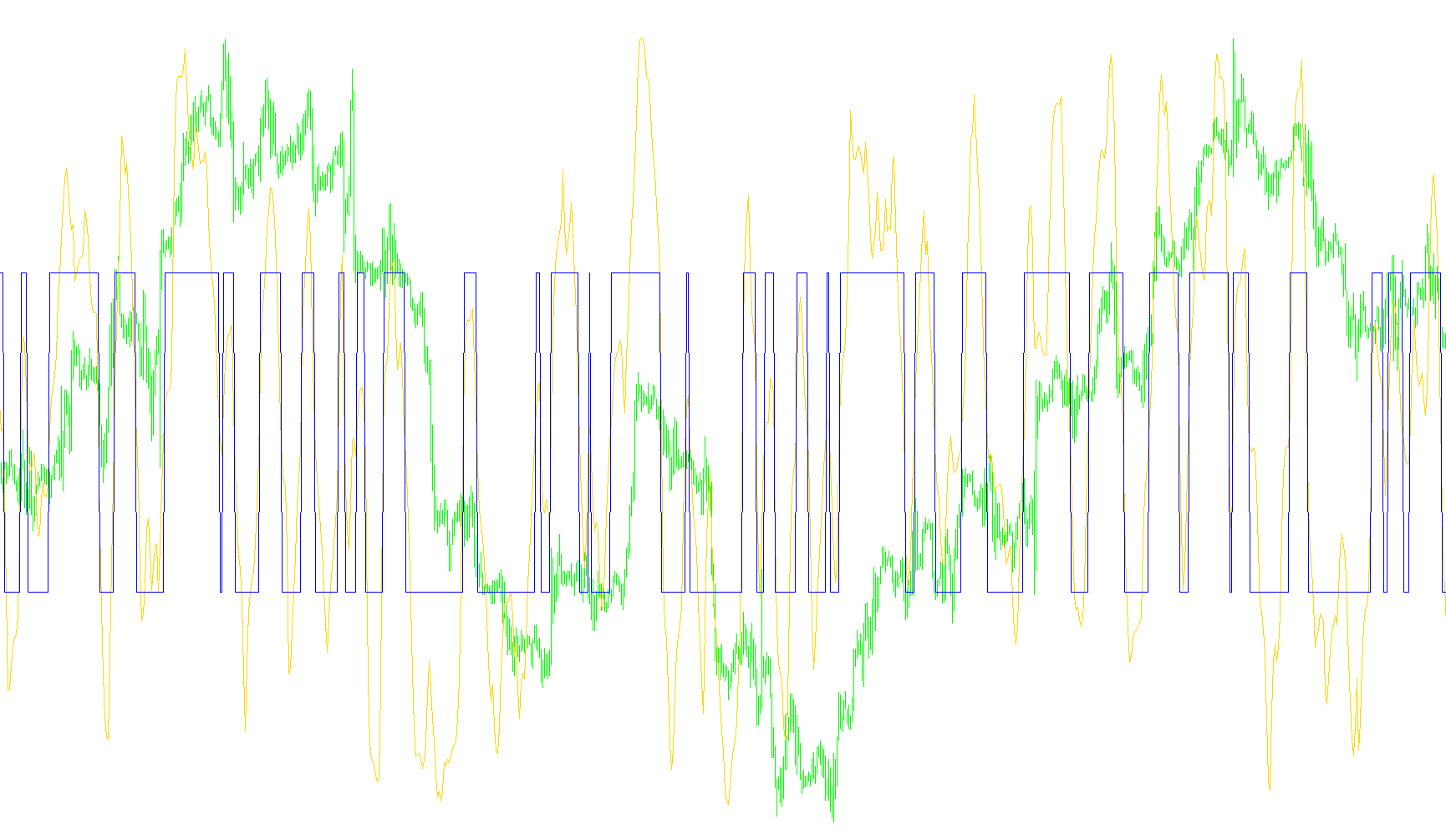
The TTF (True Trend Force) indicator is designed to provide traders with a visual representation of market momentum by analyzing price extremes over specific timeframes. It focuses on identifying whether the prevailing "power" in the market is leaning toward a bullish trend (buying pressure) or a bearish trend (selling pressure).
Core Logic and Mechanics
1. Price Extreme Analysis The indicator operates by scanning the market to find the highest highs and lowest lows within two distinct windows of time. By comparing the most recent price peaks and valleys against older historical data points, the script calculates the relative strength of the movement. It essentially measures how much "ground" the current trend has gained compared to the previous period.
2. Power Calculation The logic defines two types of momentum:
- Buy Power: Calculated by comparing the most recent high against an older low.
- Sell Power: Calculated by comparing an older high against the most recent low.
By subtracting these values and normalizing them against the total combined power, the script produces a percentage-based trend force. This tells the user if the market is pushing upward or downward relative to its recent range.
3. Smoothing and Stability To prevent the indicator from reacting too erratically to minor price fluctuations (market "noise"), the script applies a multi-stage smoothing process. It utilizes a weighted calculation that blends the current trend force with previous data points. This ensures that the resulting line on the chart movesFluidly, highlighting long-term trends rather than every tiny tick in price.
4. Signal Generation The indicator provides two visual components:
- The Main Line: A smoothed, fluctuating line that tracks the actual trend force as it shifts between positive and negative values.
- The Signal Line: This is a binary reference line. It acts as a clear threshold; when the main trend force moves into positive territory, the signal stays at a set upper boundary (representing bullish dominance). When the trend force drops below zero, the signal moves to a lower boundary (representing bearish dominance).
Summary for the User
In practical terms, this tool helps you see the "tug-of-war" between buyers and sellers. It identifies when the market is gaining significant momentum in one direction and provides a smoothed visual path so you can better recognize shifts in trend direction without getting distracted by minor price noise.
//+------------------------------------------------------------------+
//|                                                   ttf.mq4        |
//|                      Copyright © 2005, Nick Bilak                |
//|                                                                  |
//+------------------------------------------------------------------+
#property copyright "Copyright © 2005, Nick Bilak"
#property link      "beluck[at]gmail.com"

#property indicator_separate_window
#property indicator_buffers 2
#property indicator_color1 LightSeaGreen
#property indicator_color2 Red
//---- input parameters
extern int TTFbars=8;
//15=default number of bars for computation
extern int TopLine=75;
extern int BottomLine=-75;
extern int t3_period=3;
extern double b=0.7;
//---- buffers
double MainBuffer[];
double SignalBuffer[];
//----
int draw_begin1=0;
int draw_begin2=0;
double b2=0;
double b3=0;
double c1=0;
double c2=0;
double c3=0;
double c4=0;
double r=0;
double w1=0;
double w2=0;
double e1 = 0;
double e2 = 0;
double e3 = 0;
double e4 = 0;
double e5 = 0;
double e6 = 0;
double  HighestHighRecent=0;
double  HighestHighOlder =0;
double  LowestLowRecent =0;
double  LowestLowOlder =0;
double  BuyPower =0;
double  SellPower=0;
double  TTF=0;

//+------------------------------------------------------------------+
//| Custom indicator initialization function                         |
//+------------------------------------------------------------------+
int init()
  {
   string short_name;
//---- 2 additional buffers are used for counting.
   IndicatorBuffers(2);
//---- indicator lines
   SetIndexStyle(0,DRAW_LINE);
   SetIndexBuffer(0, MainBuffer);
   SetIndexStyle(1,DRAW_LINE);
   SetIndexBuffer(1, SignalBuffer);
//---- name for DataWindow and indicator subwindow label
   short_name="TTF("+TTFbars;
   IndicatorShortName(short_name);
   SetIndexLabel(0,short_name);
   SetIndexLabel(1,"Signal");
//----
   draw_begin1=TTFbars*2+1;
   draw_begin2=draw_begin1;
   SetIndexDrawBegin(0,draw_begin1);
   SetIndexDrawBegin(1,draw_begin2);

   b2=b*b;
   b3=b2*b;
   c1=-b3;
   c2=(3*(b2+b3));
   c3=-3*(2*b2+b+b3);
   c4=(1+3*b+b3+3*b2);

   r=t3_period;

   if (r<1) r=1;
   r = 1 + 0.5*(r-1);
   w1 = 2 / (r + 1);
   w2 = 1 - w1;

//----
   return(0);
  }
//+------------------------------------------------------------------+
//| ttf                                            |
//+------------------------------------------------------------------+
int start()
  {
   int    i,k;
   int    counted_bars=IndicatorCounted();
   double price;
//----
   if(Bars<=draw_begin2) return(0);
//---- initial zero
   if(counted_bars<1)
     {
      for(i=1;i<=draw_begin1;i++) MainBuffer[Bars-i]=0;
      for(i=1;i<=draw_begin2;i++) SignalBuffer[Bars-i]=0;
     }
//---- %K line
   i=Bars-draw_begin1;
   if(counted_bars>draw_begin1) i=Bars-counted_bars-1;
   while(i>=0)
     {
  HighestHighRecent=High[Highest(NULL,0,MODE_HIGH,TTFbars,i)];//High[Highest(MODE_HIGH,shift+TTFbars-1,TTFbars)];
  HighestHighOlder =High[Highest(NULL,0,MODE_HIGH,TTFbars,i+TTFbars)];//High[Highest(MODE_HIGH,shift+TTFbars*2-1,TTFbars)];
  LowestLowRecent =Low[Lowest(NULL,0,MODE_LOW,TTFbars,i)];//Low [Lowest (MODE_LOW ,shift+TTFbars-1,TTFbars)];
  LowestLowOlder =Low[Lowest(NULL,0,MODE_LOW,TTFbars,i+TTFbars)];//Low [Lowest (MODE_LOW ,shift+TTFbars*2-1,TTFbars)];
  BuyPower =HighestHighRecent-LowestLowOlder;
  SellPower=HighestHighOlder -LowestLowRecent;
  TTF=(BuyPower-SellPower)/(0.5*(BuyPower+SellPower))*100;

  e1 = w1*TTF + w2*e1;
  e2 = w1*e1 + w2*e2;
  e3 = w1*e2 + w2*e3;
  e4 = w1*e3 + w2*e4;
  e5 = w1*e4 + w2*e5;
  e6 = w1*e5 + w2*e6;

  TTF = c1*e6 + c2*e5 + c3*e4 + c4*e3;

  MainBuffer[i]=TTF;
  i--;
 }
//---- last counted bar will be recounted
   if(counted_bars>0) counted_bars--;
   int limit=Bars-counted_bars;
//---- signal line is simple movimg average
   for(i=0; i<limit; i++) {
      if (MainBuffer[i]>=0)
         SignalBuffer[i]=TopLine;
      else
         SignalBuffer[i]=BottomLine;
   }
//----
   return(0);
  }
//+------------------------------------------------------------------+
Comments