RoundLevels
Download script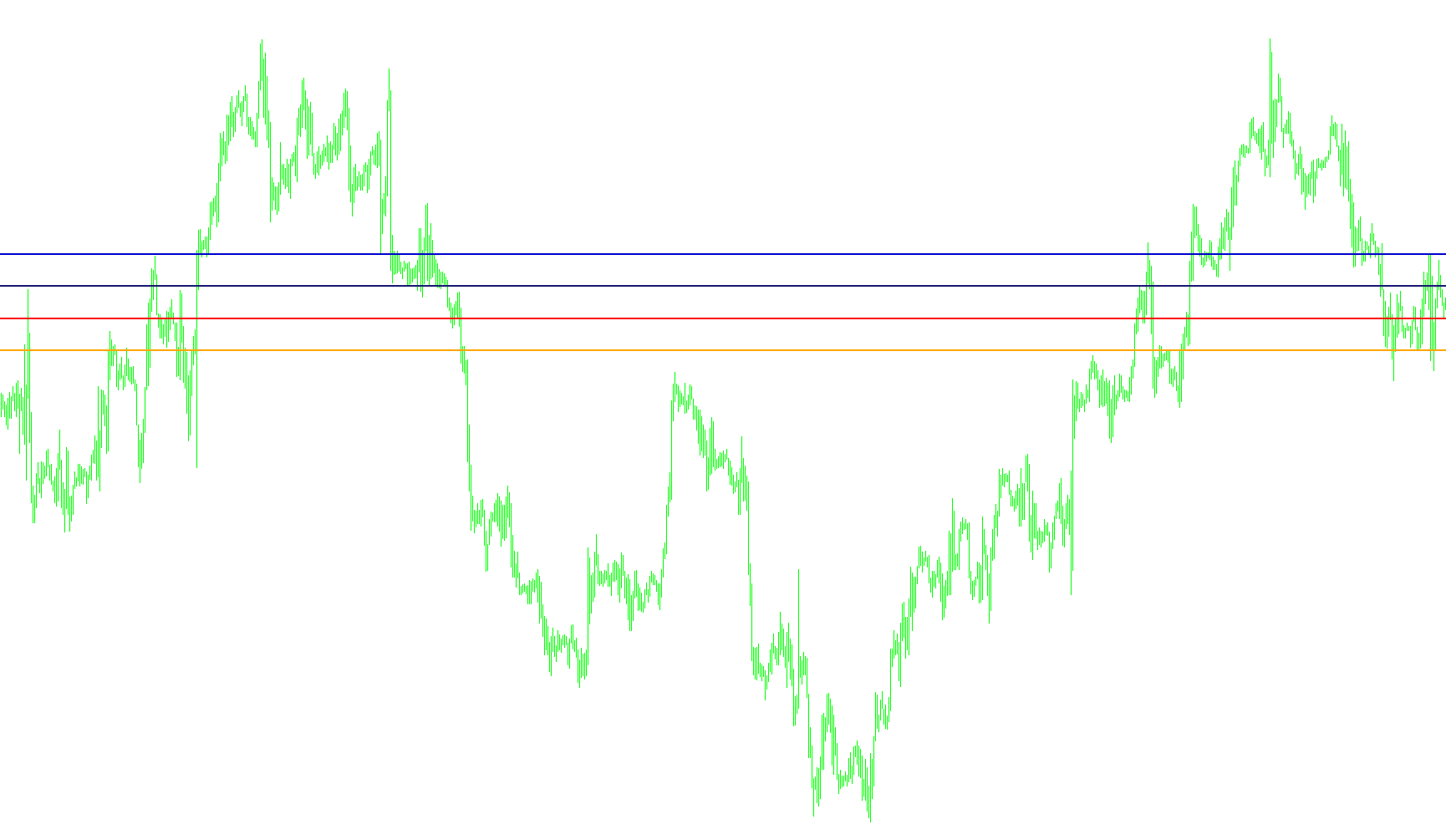
This tool is designed to provide visual clarity on a trading chart by automatically identifying and marking significant "round numbers." In financial markets, round numbers (prices ending in ".00") often act as psychological barriers where traders may place orders, leading to increased activity or price reversals at those specific levels.
How the Logic Works
The script constantly monitors the current market price and performs the following actions:
1. Identification of Primary Round Levels The tool looks at the live price and calculates the two nearest "round" milestones:
- The Lower Bound: It finds the nearest whole round number immediately below the current price.
- The Upper Bound: It finds the nearest whole round number immediately above the current price.
2. Identification of Secondary Round Levels To provide a broader perspective, the script also calculates the next set of milestones beyond the immediate ones:
- It establishes a second lower level (the round number preceding the first lower bound).
- It establishes a second upper level (the round number following the first upper bound).
3. Dynamic Visual Updates The script automatically draws four horizontal lines on your chart to represent these levels. As the market price moves, the logic dynamically updates the position of these lines in real-time. This ensures that you are always looking at the four most relevant round numbers relative to where the price is currently trading.
Key Features
- Real-Time Adjustment: The lines move automatically as the price fluctuates, keeping the most important psychological levels visible at all times.
- Customizable Visibility: Users can adjust the thickness of the lines to suit their preferred chart layout.
- Clean Chart Management: The script includes a "Keep Traces" feature. When turned off, it ensures that only the current relevant lines are displayed, preventing the chart from becoming cluttered with old data.
- Automatic Cleanup: When you remove the tool from your chart, the script automatically deletes the lines it created, leaving your workspace clean.
//+------------------------------------------------------------------+
//|                                                  RoundLevels.mq4 |
//|                                        Version 2, "For Codebase" |
//|                                                   Author: Martes |
//|               http://championship.mql4.com/2007/ru/users/Martes/ |
//+------------------------------------------------------------------+
/*
   This code draws 4 horizontal lines with "00" at the end of
   the vertical coordinate (price). This 4 horizontal lines with
   this property are closest to current price.
*/

#property copyright "Martes"
#property link      "http://championship.mql4.com/2007/ru/users/Martes/"

#property indicator_chart_window
#property indicator_buffers 4
#property indicator_color1 Red
#property indicator_color2 MidnightBlue
#property indicator_color3 Orange
#property indicator_color4 MediumBlue

//Width of horizontal lines
extern int LineWidth=2;
//Do we need the previous value of the indicator?
extern bool KeepTraces;

//---- buffers
double Lower1[];
double Upper1[];
double Lower2[];
double Upper2[];
//---- names of horizontal lines
string Lower1Line="Lower1Line",
       Upper1Line="Upper1Line",
       Lower2Line="Lower2Line",
       Upper2Line="Upper2Line";
//+------------------------------------------------------------------+
//| Custom indicator initialization function                         |
//+------------------------------------------------------------------+
int init()
  {
//---- indicators
   SetIndexStyle(0,DRAW_LINE);
   SetIndexBuffer(0,Lower1);
   SetIndexStyle(1,DRAW_LINE);
   SetIndexBuffer(1,Upper1);
   SetIndexStyle(2,DRAW_LINE);
   SetIndexBuffer(2,Lower2);
   SetIndexStyle(3,DRAW_LINE);
   SetIndexBuffer(3,Upper2);
//---- initial indicator values
   //closest lower "round" bound for price change
    Lower1[0]=MathFloor((Close[0]/Point)/100)*Point*100;
    //closest upper "round" bound for price change
    Upper1[0]=MathCeil((Close[0]/Point)/100)*Point*100;
    //next lower "round" bound (after Lower1) for price change
    Lower2[0]=Lower1[0]-100*Point;
    //next upper "round" bound (after Upper1) for price change
    Upper2[0]=Upper1[0]+100*Point;
//---- create horizontal lines
   if(!ObjectCreate(Lower1Line, OBJ_HLINE, 0, D'2004.02.20 12:30', Lower1[0]))
    {
     Print("error: can't create horizontal line! code #",GetLastError());
     return(0);
    }
    else
    {
      ObjectSet(Lower1Line, OBJPROP_COLOR, indicator_color1);
      ObjectSet(Lower1Line, OBJPROP_WIDTH, LineWidth);
    }
    if(!ObjectCreate(Upper1Line, OBJ_HLINE, 0, D'2004.02.20 12:30', Upper1[0]))
    {
     Print("error: can't create horizontal line! code #",GetLastError());
     return(0);
    }
    else
    {
      ObjectSet(Upper1Line, OBJPROP_COLOR, indicator_color2);
      ObjectSet(Upper1Line, OBJPROP_WIDTH, LineWidth);
    }
    if(!ObjectCreate(Lower2Line, OBJ_HLINE, 0, D'2004.02.20 12:30', Lower2[0]))
    {
     Print("error: can't create horizontal line! code #",GetLastError());
     return(0);
    }
    else
    {
      ObjectSet(Lower2Line, OBJPROP_COLOR, indicator_color3);
      ObjectSet(Lower2Line, OBJPROP_WIDTH, LineWidth);
    }
    if(!ObjectCreate(Upper2Line, OBJ_HLINE, 0, D'2004.02.20 12:30', Upper2[0]))
    {
     Print("error: can't create horizontal line! code #",GetLastError());
     return(0);
    }
    else
    {
      ObjectSet(Upper2Line, OBJPROP_COLOR, indicator_color4);
      ObjectSet(Upper2Line, OBJPROP_WIDTH, LineWidth);
    }
//--- horizontal lines created
   return(0);
  }
//+------------------------------------------------------------------+
//| Custom indicator deinitialization function                       |
//+------------------------------------------------------------------+
int deinit()
  {
//----
   if(ObjectFind(Lower1Line)==0)
      ObjectDelete(Lower1Line);
   if(ObjectFind(Upper1Line)==0)
      ObjectDelete(Upper1Line);
   if(ObjectFind(Lower2Line)==0)
      ObjectDelete(Lower2Line);
   if(ObjectFind(Upper2Line)==0)
      ObjectDelete(Upper2Line);
//----
   return(0);
  }
//+------------------------------------------------------------------+
//| Custom indicator iteration function                              |
//+------------------------------------------------------------------+
int start()
  {
   int    counted_bars=IndicatorCounted();
//----
    //closest lower "round" bound for price change
    Lower1[0]=MathFloor((Close[0]/Point)/100)*Point*100;
    //closest upper "round" bound for price change
    Upper1[0]=MathCeil((Close[0]/Point)/100)*Point*100;
    //next lower "round" bound (after Lower1) for price change
    Lower2[0]=Lower1[0]-100*Point;
    //next upper "round" bound (after Upper1) for price change
    Upper2[0]=Upper1[0]+100*Point;
//----
   if(ObjectFind(Lower1Line)==0)
      ObjectSet(Lower1Line, OBJPROP_PRICE1, Lower1[0]);
   if(ObjectFind(Upper1Line)==0)
      ObjectSet(Upper1Line, OBJPROP_PRICE1, Upper1[0]);
   if(ObjectFind(Lower2Line)==0)
     ObjectSet(Lower2Line, OBJPROP_PRICE1, Lower2[0]);
   if(ObjectFind(Upper2Line)==0)
      ObjectSet(Upper2Line, OBJPROP_PRICE1, Upper2[0]);
//----
   if(!KeepTraces)
   {
      Lower1[1]=EMPTY_VALUE;
      Upper1[1]=EMPTY_VALUE;
      Lower2[1]=EMPTY_VALUE;
      Upper2[1]=EMPTY_VALUE;
   }
   return(0);
  }
//+------------------------------------------------------------------+
Comments