Fractal AMA
Download script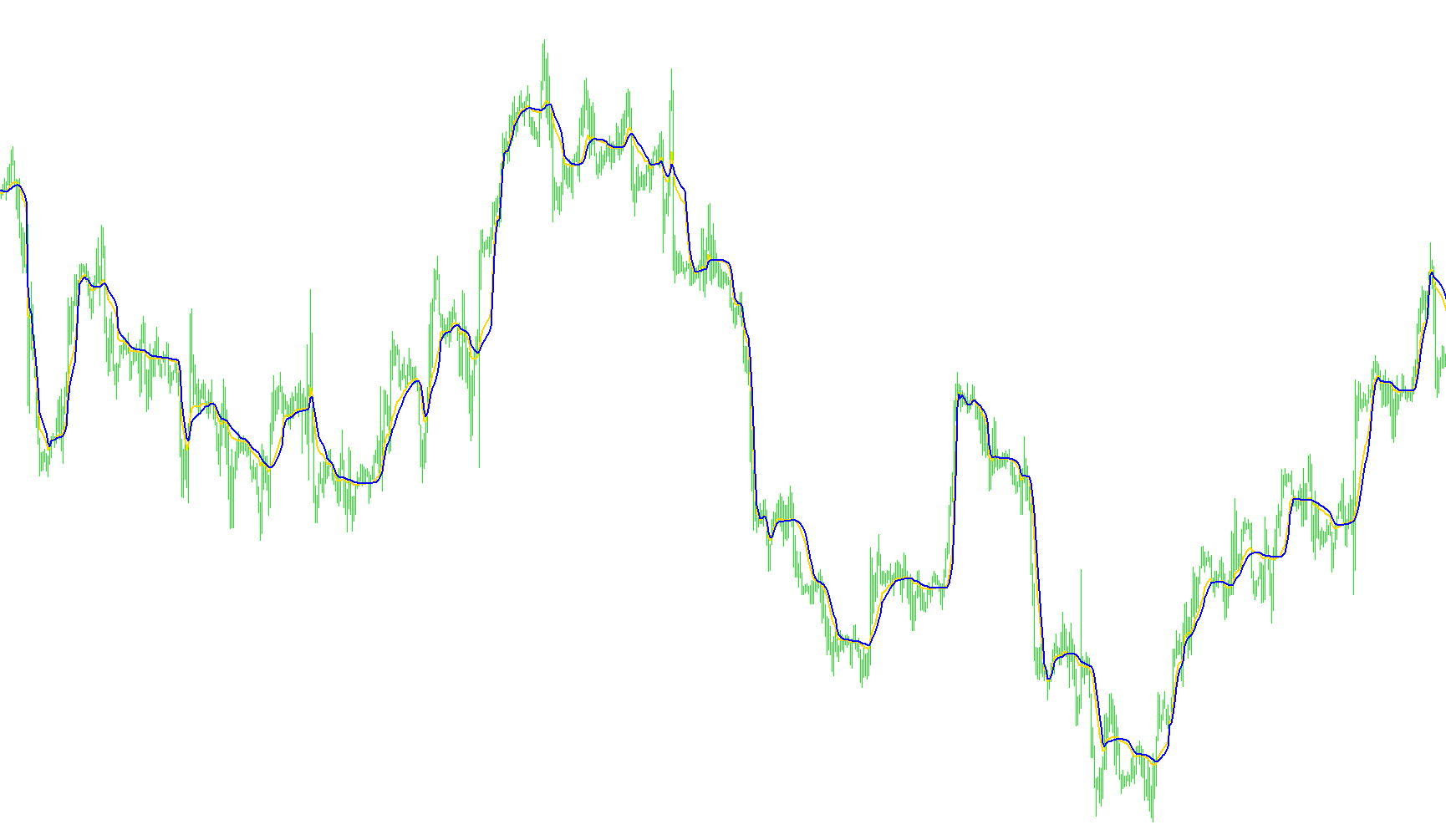
The Fractal Adaptive Moving Average (FRAMA) is a sophisticated technical analysis tool designed to track market trends by dynamically adjusting its sensitivity based on the "dimension" or complexity of current price action. Unlike standard moving averages that apply a fixed weight to past data, this script analyzes how "rough" or "smooth" the market is moving to decide how quickly it should react.
Core Logic and Behavior
The underlying logic operates through three primary stages:
1. Dimensionality Estimation
The tool first measures the complexity of the price movement over a specific period (defined by the RPeriod). It calculates the range of price highs and lows across different segments of time. By comparing these segments, the script estimates a "fractal dimension."
- In a very smooth, trending market, the fractal dimension is low.
- In a volatile, jagged, or sideways market, the fractal dimension is high.
2. Dynamic Sensitivity Adjustment (Alpha) Once the fractal dimension is determined, the script uses it to calculate two distinct "adaptation factors" (represented as Alpha). These factors act like a volume knob for the moving average:
- High Stability: When the market is moving steadily in one direction, the adaptation factor allows the moving average to stay glued to the price, providing a clear trend signal without being distracted by minor noise.
- High Volatility: When the market becomes erratic or choppy, the script automatically lowers its sensitivity. This prevents the moving average from "wiggling" too much, which helps filter out fake signals during consolidation phases.
3. Dual-Layer Output The script produces two distinct lines on your chart to help with trend identification:
- The Primary Fractal Moving Average: This is the main line that tracks the price using the calculated adaptation factor. It provides the immediate "heartbeat" of the current trend.
- The Signal Line: This is a secondary, smoothed version of the primary average (calculated using its own specific multiplier). By observing the relationship between these two lines, traders can identify changes in momentum—such as when the price begins to curl away from the moving average or when the two lines cross.
Summary for the User
Essentially, this tool is designed to be "smart." It attempts to solve the biggest problem with standard moving averages: being too slow during trends and too reactive during noise. By constantly measuring the market's fractal nature, it tries to automatically speed up when there is a clear path forward and slow down when the market is just "making noise," providing a cleaner visual representation of price action.
//
//+------------------------------------------------------------------+
// FractalAMA
//
// Description:  Fractal Adaptive Moving Average - by John Ehlers
// Version 1.1 7/17/2006
//
// Heavily modified and reprogrammed by Matt Kennel (mbkennelfx@gmail.com)
//
// Notes:
// October 2005 Issue - "FRAMA - Fractal Adaptive Moving Average"
//  Length will be forced to be an even number. Odd numbers will be bumped up to the
//  next even number.
// Formula Parameters:     Defaults:
// RPeriod                              16

#property  copyright "Copyright © 2005, MrPip "  // and mbkennel
#property  link      "http://www.metaquotes.net/"

//---- indicator settings
#property  indicator_chart_window
#property  indicator_buffers 2
#property indicator_color1 Red
#property indicator_color2 Blue

//---- buffers
double ExtMapBuffer1[];
double ExtMapBuffer2[];

extern int RPeriod = 16;
extern double multiplier = 4.6;
extern double signal_multiplier = 2.5;

//+------------------------------------------------------------------+
//| Custom indicator initialization function                         |
//+------------------------------------------------------------------+
int init()
  {


//---- 1 additional buffers are used for counting.
   IndicatorBuffers(2);

//---- drawing settings
   SetIndexBuffer(0,ExtMapBuffer1);
   SetIndexStyle(0,DRAW_LINE,STYLE_SOLID,2);
   SetIndexShift(0,0);
   IndicatorDigits(MarketInfo(Symbol(),MODE_DIGITS));
   SetIndexBuffer(1,ExtMapBuffer2);
   SetIndexStyle(1,DRAW_LINE,STYLE_SOLID,2);
   SetIndexShift(1,0);


//---- initialization done
   return(0);
  }

int start()
{
     int    i,k,counted_bars=IndicatorCounted();

     if (Bars < RPeriod) return(0);
     Comment("Bars : ",Bars);
     int maxshift = Bars-RPeriod-1;
     int limit= maxshift - counted_bars;
     if (limit < 1) limit = 1;

     int N = MathFloor(RPeriod/2)*2;  // Force N to even number
     double frama = Close[maxshift];
     double signal = frama;

     ExtMapBuffer1[maxshift] = Close[maxshift];
     ExtMapBuffer2[maxshift] = Close[maxshift];

     for(int shift = limit-1; shift >= 0; shift--) {
        double dimension_estimate = DEst(shift,N);

        double alpha = MathExp(-multiplier*(dimension_estimate-1.0));
        double alphas = MathExp(-signal_multiplier*(dimension_estimate-1.0));

        if (alpha > 1.0) alpha = 1.0;
        if (alpha < 0.01) alpha = 0.01;
        if (alphas > 1.0) alphas = 1.0;
        if (alphas < 0.01) alphas = 0.01;

        frama = alpha* Close[shift] + (1.0-alpha)* ExtMapBuffer1[shift+1];
        signal = alphas * frama + (1.0 - alphas)* ExtMapBuffer2[shift+1];

        ExtMapBuffer1[shift] = frama;
        ExtMapBuffer2[shift] = signal;


      }
   return(0);
}


double DEst(int shift, int n) {
   //
   double R1, R2, R3;
   int n2 = n/2;

   R3 = Range(shift,n) / n;
   R1 = Range(shift,n2) / n2;
   R2 = Range(shift+n2,n2) / n2;

   return(  (MathLog(R1+R2)-MathLog(R3) )* 1.442695 ) ; // log_2(e) = 1.442694


}

double Range(int i, int k) {

      return( High[Highest(NULL,0,MODE_HIGH,k,i)] - Low[Lowest(NULL,0,MODE_LOW,k,i)] );
}
Comments