BBANDS~1_001
Download script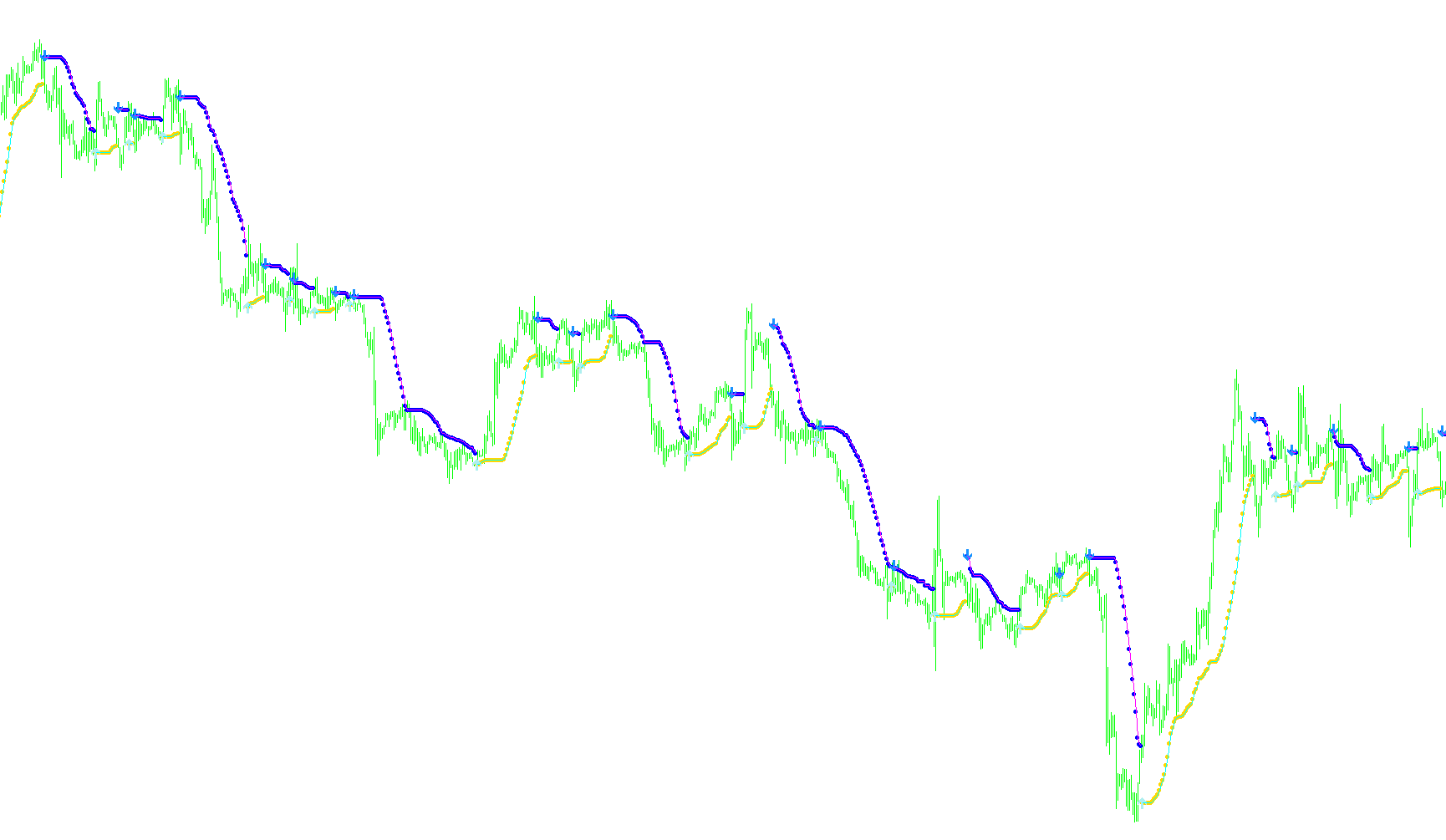
This script is designed to help traders identify trend direction and visualize potential "stop-loss" levels on a price chart using a modified version of the Bollinger Bands technical indicator. Instead of just showing standard volatility bands, this tool focuses on creating dynamic trailing boundaries that adjust based on price action and user-defined risk preferences.
Core Logic and Functionality
1. Trend Detection The script constantly monitors the relationship between the current market price and the standard Bollinger Bands (upper and lower boundaries).
- Bullish Trend: If the price closes above the upper band, the system recognizes an upward trend.
- Bearish Trend: If the price closes below the lower band, the system recognizes a downward trend.
2. Dynamic Boundary Calculation Unlike standard bands that may expand and contract freely, this script introduces a "locking" logic to the boundaries:
- In an Upward Trend, the lower boundary is designed to only move higher as price moves up; it will not drop lower if the market fluctuates downward.
- In a Downward Trend, the upper boundary is designed to only move lower as price moves down; it will not rise if the market bounces upward.
3. Risk-Adjusted Offsets (MoneyRisk) The script includes a customizable "MoneyRisk" factor. This allows users to mathematically shift the trend lines further away from the current price. By adjusting this factor, traders can create a wider or narrower "buffer zone" between the current market price and their visual stop-loss line, depending on their specific risk tolerance.
4. Visual Signals and Alerts The tool provides several ways for a trader to interact with the data:
- Trend Lines: It draws continuous lines representing the calculated "Stop" levels for both upward and downward movements.
- Visual Signals: Depending on user settings, it can place specific arrows or markers on the chart to indicate exactly when a trend shift is detected.
- Audio Notifications: The script features an alert system that provides a sound notification the moment the logic detects a reversal (e.g., switching from an upward trend to a downward trend).
Summary for the Trader
Essentially, this script acts as a "Trend Follower." It looks for breakouts of volatility bands and then draws a trailing line that "locks" in your profit as the price moves in your favor. By using the risk offset, it helps you visualize where a trend might be considered broken, allowing you to manage your exit points more systematically rather than guessing based on price movement alone.
//+------------------------------------------------------------------+
//|                                               BBands_Stop_v1.mq4 |
//|                           Copyright © 2006, TrendLaboratory Ltd. |
//|            http://finance.groups.yahoo.com/group/TrendLaboratory |
//|                                       E-mail: igorad2004@list.ru |
//+------------------------------------------------------------------+
#property copyright "Copyright © 2006, TrendLaboratory Ltd."
#property link      "http://finance.groups.yahoo.com/group/TrendLaboratory"

#property indicator_chart_window
#property indicator_buffers 6
#property indicator_color1 RoyalBlue
#property indicator_color2 Red
#property indicator_color3 RoyalBlue
#property indicator_color4 Red
#property indicator_color5 RoyalBlue
#property indicator_color6 Red
//---- input parameters
extern int    Length=20;      // Bollinger Bands Period
extern int    Deviation=1;    // Deviation was 2
extern double MoneyRisk=1.00; // Offset Factor
extern int    Signal=1;       // Display signals mode: 1-Signals & Stops; 0-only Stops; 2-only Signals;
extern int    Line=1;         // Display line mode: 0-no,1-yes
extern int    Nbars=10000;
//---- indicator buffers
double UpTrendBuffer[];
double DownTrendBuffer[];
double UpTrendSignal[];
double DownTrendSignal[];
double UpTrendLine[];
double DownTrendLine[];
extern bool SoundON=true;
bool TurnedUp = false;
bool TurnedDown = false;
//+------------------------------------------------------------------+
//| Custom indicator initialization function                         |
//+------------------------------------------------------------------+
  int init()
  {
   string short_name;
//---- indicator line

   SetIndexBuffer(0,UpTrendBuffer);
   SetIndexBuffer(1,DownTrendBuffer);
   SetIndexBuffer(2,UpTrendSignal);
   SetIndexBuffer(3,DownTrendSignal);
   SetIndexBuffer(4,UpTrendLine);
   SetIndexBuffer(5,DownTrendLine);
   SetIndexStyle(0,DRAW_ARROW,0,1);
   SetIndexStyle(1,DRAW_ARROW,0,1);
   SetIndexStyle(2,DRAW_ARROW,0,1);
   SetIndexStyle(3,DRAW_ARROW,0,1);
   SetIndexStyle(4,DRAW_LINE);
   SetIndexStyle(5,DRAW_LINE);
   SetIndexArrow(0,159);
   SetIndexArrow(1,159);
   SetIndexArrow(2,233);
   SetIndexArrow(3,234);
   IndicatorDigits(MarketInfo(Symbol(),MODE_DIGITS));
//---- name for DataWindow and indicator subwindow label
   short_name="BBands Stop("+Length+","+Deviation+")";
   IndicatorShortName(short_name);
   SetIndexLabel(0,"UpTrend Stop");
   SetIndexLabel(1,"DownTrend Stop");
   SetIndexLabel(2,"UpTrend Signal");
   SetIndexLabel(3,"DownTrend Signal");
   SetIndexLabel(4,"UpTrend Line");
   SetIndexLabel(5,"DownTrend Line");
//----
   SetIndexDrawBegin(0,Length);
   SetIndexDrawBegin(1,Length);
   SetIndexDrawBegin(2,Length);
   SetIndexDrawBegin(3,Length);
   SetIndexDrawBegin(4,Length);
   SetIndexDrawBegin(5,Length);
//----
   return(0);
  }

//+------------------------------------------------------------------+
//| Bollinger Bands_Stop_v1                                             |
//+------------------------------------------------------------------+
int start()
  {
   int    i,shift,trend;
   double smax[25000],smin[25000],bsmax[25000],bsmin[25000];

   for (shift=Nbars;shift>=0;shift--)
   {
   UpTrendBuffer[shift]=0;
   DownTrendBuffer[shift]=0;
   UpTrendSignal[shift]=0;
   DownTrendSignal[shift]=0;
   UpTrendLine[shift]=EMPTY_VALUE;
   DownTrendLine[shift]=EMPTY_VALUE;
   }

   for (shift=Nbars-Length-1;shift>=0;shift--)
   {
     smax[shift]=iBands(NULL,0,Length,Deviation,0,PRICE_CLOSE,MODE_UPPER,shift);
	  smin[shift]=iBands(NULL,0,Length,Deviation,0,PRICE_CLOSE,MODE_LOWER,shift);

	  if (Close[shift]>smax[shift+1]) trend=1;
	  if (Close[shift]<smin[shift+1]) trend=-1;

	  if(trend>0 && smin[shift]<smin[shift+1]) smin[shift]=smin[shift+1];
	  if(trend<0 && smax[shift]>smax[shift+1]) smax[shift]=smax[shift+1];

	  bsmax[shift]=smax[shift]+0.5*(MoneyRisk-1)*(smax[shift]-smin[shift]);
	  bsmin[shift]=smin[shift]-0.5*(MoneyRisk-1)*(smax[shift]-smin[shift]);

	  if(trend>0 && bsmin[shift]<bsmin[shift+1]) bsmin[shift]=bsmin[shift+1];
	  if(trend<0 && bsmax[shift]>bsmax[shift+1]) bsmax[shift]=bsmax[shift+1];

	  if (trend>0)
	  {
	     if (Signal>0 && UpTrendBuffer[shift+1]==-1.0)
	     {
	     UpTrendSignal[shift]=bsmin[shift];
	     UpTrendBuffer[shift]=bsmin[shift];
	     if(Line>0) UpTrendLine[shift]=bsmin[shift];
     if (SoundON==true && shift==0 && !TurnedUp)
         {
     Alert("BBands going Up on ",Symbol(),"-",Period());
                       TurnedUp = true;
            TurnedDown = false;
     }
	     }
	     else
	     {
	     UpTrendBuffer[shift]=bsmin[shift];
	     if(Line>0) UpTrendLine[shift]=bsmin[shift];
	     UpTrendSignal[shift]=-1;
	     }
	  if (Signal==2) UpTrendBuffer[shift]=0;
	  DownTrendSignal[shift]=-1;
	  DownTrendBuffer[shift]=-1.0;
	  DownTrendLine[shift]=EMPTY_VALUE;
	  }
	  if (trend<0)
	  {
	  if (Signal>0 && DownTrendBuffer[shift+1]==-1.0)
	     {
	     DownTrendSignal[shift]=bsmax[shift];
	     DownTrendBuffer[shift]=bsmax[shift];
	     if(Line>0) DownTrendLine[shift]=bsmax[shift];
     if (SoundON==true && shift==0 && !TurnedDown)
         {
     Alert("BBands going Down on ",Symbol(),"-",Period());
            TurnedDown = true;
            TurnedUp = false;
     }
	     }
	     else
	     {
	     DownTrendBuffer[shift]=bsmax[shift];
	     if(Line>0)DownTrendLine[shift]=bsmax[shift];
	     DownTrendSignal[shift]=-1;
	     }
	  if (Signal==2) DownTrendBuffer[shift]=0;
	  UpTrendSignal[shift]=-1;
	  UpTrendBuffer[shift]=-1.0;
	  UpTrendLine[shift]=EMPTY_VALUE;
	  }

	 }
	return(0);
 }
Comments