ZigZag_002
Download script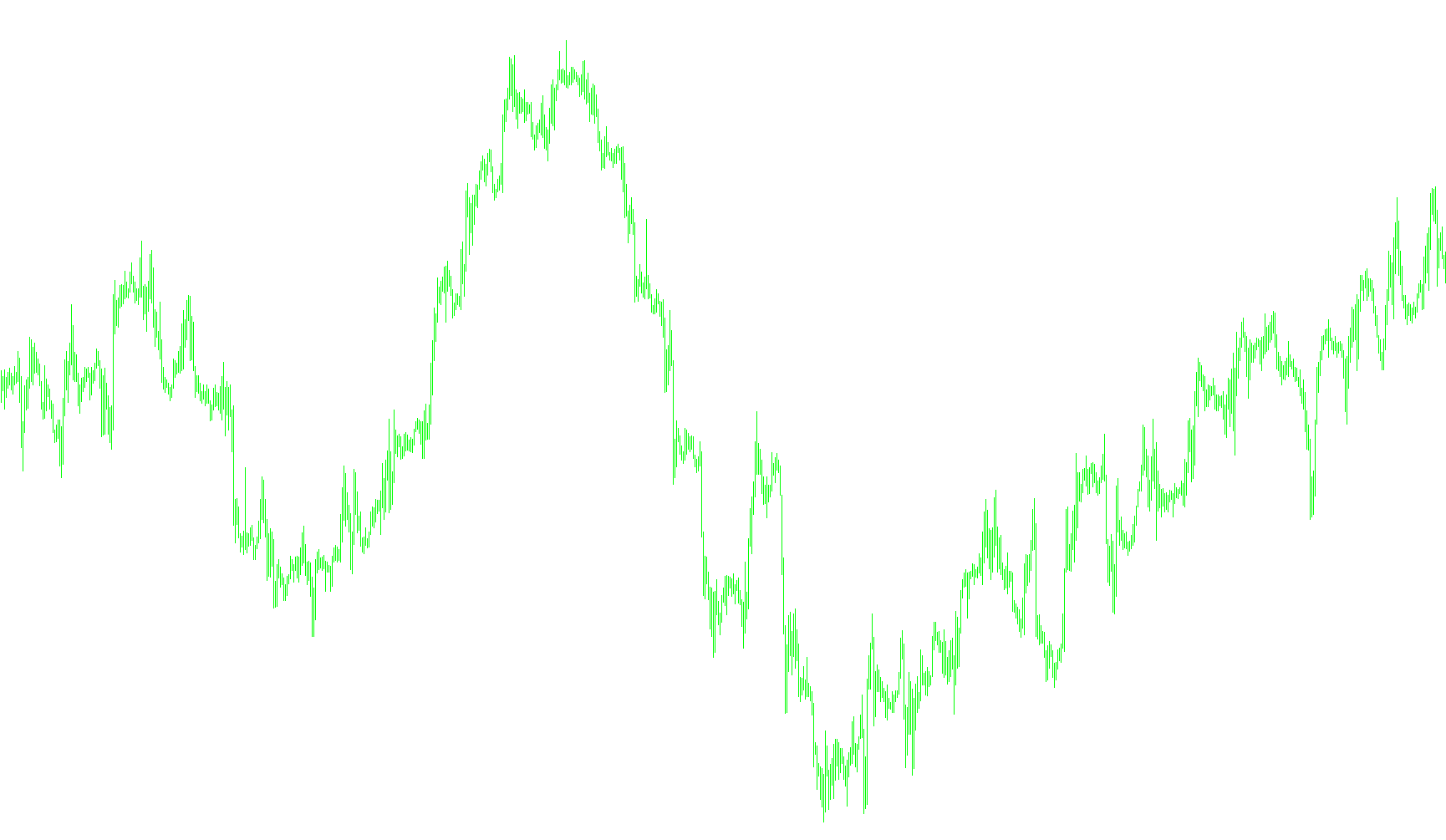
The ZigZag indicator is designed to simplify the visual complexity of financial charts by filtering out minor price fluctuations and highlighting the significant trends. Instead of showing every small movement, it identifies key structural points—specifically "peaks" (highs) and "troughs" (lows)—to map out the overall direction of the market.
Core Logic and Workflow
The script operates through a three-stage process to ensure that only meaningful price movements are displayed as connected lines:
1. Identification of Potential Extremes The tool scans historical price data based on user-defined sensitivity settings (Depth, Deviation, and Backstep). It looks for the highest highs and lowest lows within specific windows of time. To prevent the indicator from reacting to every tiny "tick" or "noise" in the market, it applies a threshold: a new point is only considered significant if it moves away from the previous point by a specific minimum amount.
2. Validation and Filtering Once potential highs and lows are identified, the script performs a secondary check. It looks backward to ensure that a detected point is indeed a local maximum or minimum relative to its immediate neighbors. If a higher peak appears slightly later in time than the one initially found, the script "corrects" itself by prioritizing the most extreme value, ensuring the lines remain accurate to the true market limits.
3. Connection and Trend Mapping The final stage of the logic involves drawing the actual ZigZag line. The script intelligently switches its focus depending on where the price is moving:
- If it identifies a low point (a trough), it begins searching for the next high point (the peak).
- Once a new high is established, it then searches for the subsequent low.
By constantly alternating between looking for "peaks" and "troughs," the script creates a continuous, clean zigzag pattern. If a new price point exceeds the previous one before a trend is completed (for example, a higher peak is reached while looking for a high), the script will automatically move the previous point to the new, more extreme location.
Key Visual Result
The final output is a series of connected segments that ignore "choppy" sideways movement and clearly illustrate the market's structural anatomy. This allows traders to easily identify support and resistance levels, trend reversals, and the overall volatility of the asset at a glance.
//+------------------------------------------------------------------+
//|                                                       Zigzag.mq4 |
//|                 Copyright © 2005-2007, MetaQuotes Software Corp. |
//|                                       http://www.metaquotes.net/ |
//+------------------------------------------------------------------+
#property copyright "Copyright © 2007, MetaQuotes Software Corp."
#property link      "http://www.metaquotes.net/"

#property indicator_chart_window
#property indicator_buffers 1
#property indicator_color1 Red
//---- indicator parameters
extern int ExtDepth=12;
extern int ExtDeviation=5;
extern int ExtBackstep=3;
//---- indicator buffers
double ZigzagBuffer[];
double HighMapBuffer[];
double LowMapBuffer[];
int level=3; // recounting's depth
bool downloadhistory=false;
//+------------------------------------------------------------------+
//| Custom indicator initialization function                         |
//+------------------------------------------------------------------+
int init()
  {
   IndicatorBuffers(3);
//---- drawing settings
   SetIndexStyle(0,DRAW_SECTION);
//---- indicator buffers mapping
   SetIndexBuffer(0,ZigzagBuffer);
   SetIndexBuffer(1,HighMapBuffer);
   SetIndexBuffer(2,LowMapBuffer);
   SetIndexEmptyValue(0,0.0);

//---- indicator short name
   IndicatorShortName("ZigZag("+ExtDepth+","+ExtDeviation+","+ExtBackstep+")");
//---- initialization done
   return(0);
  }
//+------------------------------------------------------------------+
//|                                                                  |
//+------------------------------------------------------------------+
int start()
  {
   int i, counted_bars = IndicatorCounted();
   int limit,counterZ,whatlookfor;
   int shift,back,lasthighpos,lastlowpos;
   double val,res;
   double curlow,curhigh,lasthigh,lastlow;

   if (counted_bars==0 && downloadhistory) // history was downloaded
     {
      ArrayInitialize(ZigzagBuffer,0.0);
      ArrayInitialize(HighMapBuffer,0.0);
      ArrayInitialize(LowMapBuffer,0.0);
     }
   if (counted_bars==0)
     {
      limit=Bars-ExtDepth;
      downloadhistory=true;
     }
   if (counted_bars>0)
     {
      while (counterZ<level && i<100)
        {
         res=ZigzagBuffer[i];
         if (res!=0) counterZ++;
         i++;
        }
      i--;
      limit=i;
      if (LowMapBuffer[i]!=0)
        {
         curlow=LowMapBuffer[i];
         whatlookfor=1;
        }
      else
        {
         curhigh=HighMapBuffer[i];
         whatlookfor=-1;
        }
      for (i=limit-1;i>=0;i--)
        {
         ZigzagBuffer[i]=0.0;
         LowMapBuffer[i]=0.0;
         HighMapBuffer[i]=0.0;
        }
     }

   for(shift=limit; shift>=0; shift--)
     {
      val=Low[iLowest(NULL,0,MODE_LOW,ExtDepth,shift)];
      if(val==lastlow) val=0.0;
      else
        {
         lastlow=val;
         if((Low[shift]-val)>(ExtDeviation*Point)) val=0.0;
         else
           {
            for(back=1; back<=ExtBackstep; back++)
              {
               res=LowMapBuffer[shift+back];
               if((res!=0)&&(res>val)) LowMapBuffer[shift+back]=0.0;
              }
           }
        }
      if (Low[shift]==val) LowMapBuffer[shift]=val; else LowMapBuffer[shift]=0.0;
      //--- high
      val=High[iHighest(NULL,0,MODE_HIGH,ExtDepth,shift)];
      if(val==lasthigh) val=0.0;
      else
        {
         lasthigh=val;
         if((val-High[shift])>(ExtDeviation*Point)) val=0.0;
         else
           {
            for(back=1; back<=ExtBackstep; back++)
              {
               res=HighMapBuffer[shift+back];
               if((res!=0)&&(res<val)) HighMapBuffer[shift+back]=0.0;
              }
           }
        }
      if (High[shift]==val) HighMapBuffer[shift]=val; else HighMapBuffer[shift]=0.0;
     }

   // final cutting
   if (whatlookfor==0)
     {
      lastlow=0;
      lasthigh=0;
     }
   else
     {
      lastlow=curlow;
      lasthigh=curhigh;
     }
   for (shift=limit;shift>=0;shift--)
     {
      res=0.0;
      switch(whatlookfor)
        {
         case 0: // look for peak or lawn
            if (lastlow==0 && lasthigh==0)
              {
               if (HighMapBuffer[shift]!=0)
                 {
                  lasthigh=High[shift];
                  lasthighpos=shift;
                  whatlookfor=-1;
                  ZigzagBuffer[shift]=lasthigh;
                  res=1;
                 }
               if (LowMapBuffer[shift]!=0)
                 {
                  lastlow=Low[shift];
                  lastlowpos=shift;
                  whatlookfor=1;
                  ZigzagBuffer[shift]=lastlow;
                  res=1;
                 }
              }
             break;
         case 1: // look for peak
            if (LowMapBuffer[shift]!=0.0 && LowMapBuffer[shift]<lastlow && HighMapBuffer[shift]==0.0)
              {
               ZigzagBuffer[lastlowpos]=0.0;
               lastlowpos=shift;
               lastlow=LowMapBuffer[shift];
               ZigzagBuffer[shift]=lastlow;
               res=1;
              }
            if (HighMapBuffer[shift]!=0.0 && LowMapBuffer[shift]==0.0)
              {
               lasthigh=HighMapBuffer[shift];
               lasthighpos=shift;
               ZigzagBuffer[shift]=lasthigh;
               whatlookfor=-1;
               res=1;
              }
            break;
         case -1: // look for lawn
            if (HighMapBuffer[shift]!=0.0 && HighMapBuffer[shift]>lasthigh && LowMapBuffer[shift]==0.0)
              {
               ZigzagBuffer[lasthighpos]=0.0;
               lasthighpos=shift;
               lasthigh=HighMapBuffer[shift];
               ZigzagBuffer[shift]=lasthigh;
              }
            if (LowMapBuffer[shift]!=0.0 && HighMapBuffer[shift]==0.0)
              {
               lastlow=LowMapBuffer[shift];
               lastlowpos=shift;
               ZigzagBuffer[shift]=lastlow;
               whatlookfor=1;
              }
            break;
         default: return;
        }
     }

   return(0);
  }
//+------------------------------------------------------------------+
Comments