VoltyChoppy_v1_002
Download script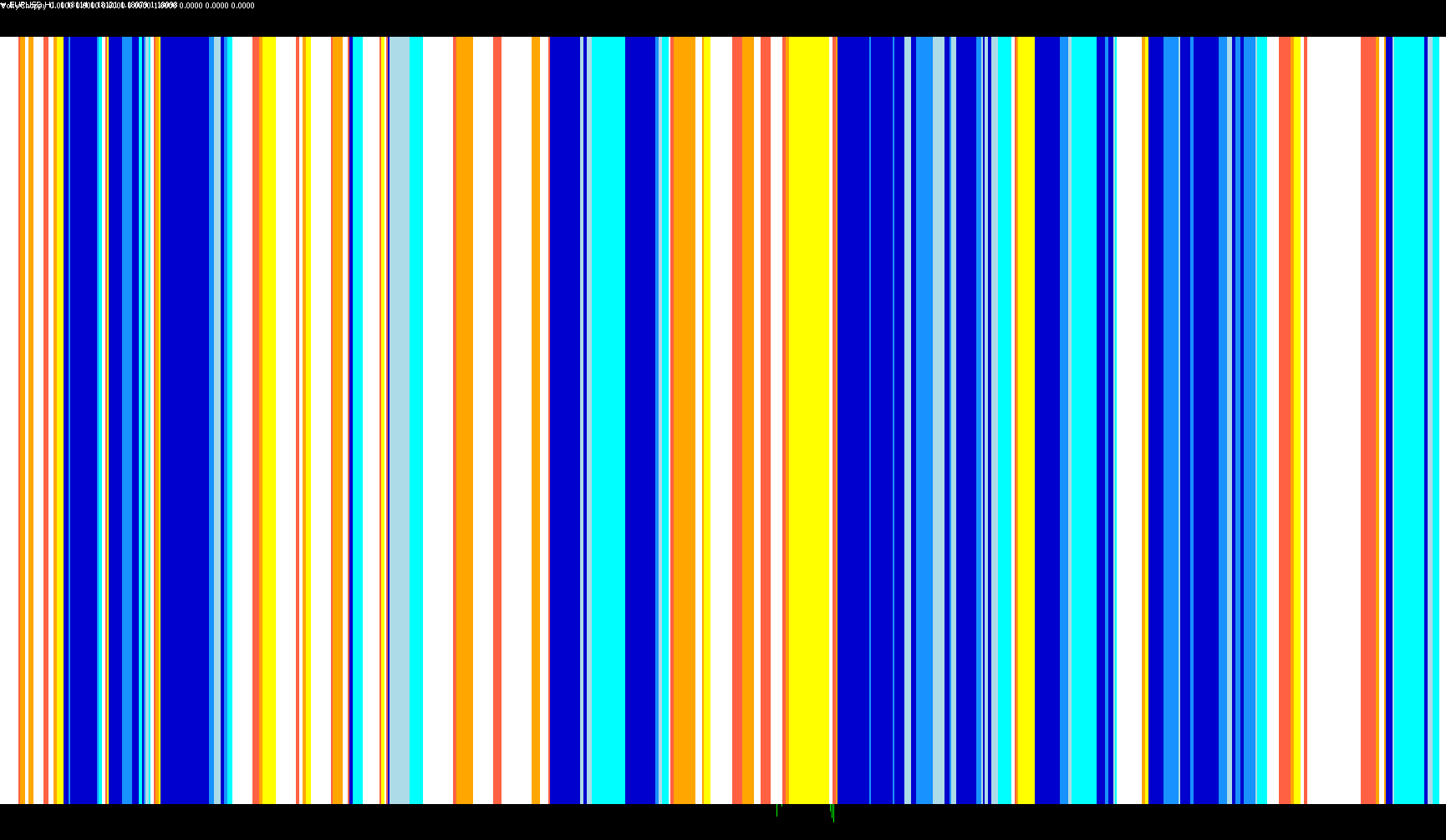
The VoltyChoppy indicator is designed to analyze market trends by evaluating the intensity of price movements relative to recent volatility. Instead of just showing you where the price is going, it categorizes the "quality" and "strength" of the current trend into four distinct stages for both upward and downward movements.
Core Logic and Methodology
The script functions by measuring the distance between current prices and a calculated volatility range (based on the Average True Range). It then creates four different layers of sensitivity to determine what kind of environment the market is currently experiencing.
By adjusting these sensitivity levels, the indicator identifies whether a trend is aggressive and healthy or if it is becoming exhausted and "choppy."
The Four Trend States
The indicator visualizes eight different conditions (four for each direction) using a color-coded histogram:
Upward Trends (Blue Shades):
- Strong UpTrend: Indicates the price is moving aggressively upward with high momentum.
- Retrace UpTrend: Shows that while the general trend is still up, the price is currently experiencing a slight pull-back or breather.
- Choppy UpTrend: Signals a weak upward movement where the price is struggling to maintain clear direction and is moving erratically.
- Be Ready to Change UpTrend: A warning signal suggesting that the upward momentum is fading significantly and a reversal may be imminent.
Downward Trends (Red/Warm Shades):
- Strong DownTrend: Indicates a heavy, aggressive sell-off with high momentum.
- Retrace DownTrend: Shows a general downward trend with a temporary slight recovery or stabilization.
- Choppy DownTrend: Signals a weak downward movement where price action is disorganized and lacks conviction.
- Be Ready to Change DownTrend: A warning signal suggesting that the downward pressure is exhausting and a reversal might be approaching.
How it Works for the User
The script continuously calculates these boundaries in real-time. When the market price breaks out of certain "volatility zones," the indicator shifts the color of the histogram to reflect the current state. This allows you to quickly distinguish between a high-probability trend and a "noisy" market where trading might be risky due to lack of clear direction.
//+------------------------------------------------------------------+
//|                                               VoltyChoppy_v1.mq4 |
//|                                  Copyright © 2006, Forex-TSD.com |
//|                         Written by IgorAD,igorad2003@yahoo.co.uk |
//|            http://finance.groups.yahoo.com/group/TrendLaboratory |
//+------------------------------------------------------------------+
#property copyright "Copyright © 2006, Forex-TSD.com "
#property link      "http://www.forex-tsd.com/"

#property indicator_separate_window
#property indicator_minimum -0.05
#property indicator_maximum 1.05
#property indicator_buffers 8

//---- input parameters
extern int     Length      = 10;
extern double  Kv          = 4.0;
//extern double  Kd          = 1.1;
extern int     NumBars     = 1000;
//---- buffers
double UpBuffer1[];
double UpBuffer2[];
double UpBuffer3[];
double UpBuffer4[];

double DnBuffer1[];
double DnBuffer2[];
double DnBuffer3[];
double DnBuffer4[];

//+------------------------------------------------------------------+
//| Custom indicator initialization function                         |
//+------------------------------------------------------------------+
int init()
  {

//----
   SetIndexStyle(0,DRAW_HISTOGRAM,0,3,MediumBlue);
   SetIndexStyle(1,DRAW_HISTOGRAM,0,3,DodgerBlue);
   SetIndexStyle(2,DRAW_HISTOGRAM,0,3,LightBlue);
   SetIndexStyle(3,DRAW_HISTOGRAM,0,3,Aqua);

   SetIndexStyle(4,DRAW_HISTOGRAM,0,3,Crimson);
   SetIndexStyle(5,DRAW_HISTOGRAM,0,3,Tomato);
   SetIndexStyle(6,DRAW_HISTOGRAM,0,3,Orange);
   SetIndexStyle(7,DRAW_HISTOGRAM,0,3,Yellow);

   SetIndexBuffer(0,UpBuffer1);
   SetIndexBuffer(1,UpBuffer2);
   SetIndexBuffer(2,UpBuffer3);
   SetIndexBuffer(3,UpBuffer4);

   SetIndexBuffer(4,DnBuffer1);
   SetIndexBuffer(5,DnBuffer2);
   SetIndexBuffer(6,DnBuffer3);
   SetIndexBuffer(7,DnBuffer4);

//----
   string short_name="VoltyChoppy";
   IndicatorShortName(short_name);
   SetIndexLabel(0,"Strong UpTrend");
   SetIndexLabel(1,"Retrace UpTrend");
   SetIndexLabel(2,"Choppy UpTrend");
   SetIndexLabel(3,"Be ready to change UpTrend");

   SetIndexLabel(4,"Strong DownTrend");
   SetIndexLabel(5,"Retrace DownTrend");
   SetIndexLabel(6,"Choppy DownTrend");
   SetIndexLabel(7,"Be ready to change DownTrend");
//----

   SetIndexDrawBegin(0,Length);
   SetIndexDrawBegin(1,Length);
   SetIndexDrawBegin(2,Length);
   SetIndexDrawBegin(3,Length);
   SetIndexDrawBegin(4,Length);
   SetIndexDrawBegin(5,Length);
   SetIndexDrawBegin(6,Length);
   SetIndexDrawBegin(7,Length);
//----
   return(0);
  }
//+------------------------------------------------------------------+
//| VoltyChoppy_v1                                                  |
//+------------------------------------------------------------------+
int start()
  {
   double smin,smax,smin1,smax1,
          rmin,rmax,rmin1,rmax1,
          cmin,cmax,cmin1,cmax1,
          bmin,bmax,bmin1,bmax1;
   int    i, strend, rtrend, ctrend, btrend;

//----
   if(NumBars<=Length) return(0);
//---- initial zero
      for(i=Bars;i>=0;i--)
      {
      UpBuffer1[i]=0.0;
      UpBuffer2[i]=0.0;
      UpBuffer3[i]=0.0;
      UpBuffer4[i]=0.0;

      DnBuffer1[i]=0.0;
      DnBuffer2[i]=0.0;
      DnBuffer3[i]=0.0;
      DnBuffer4[i]=0.0;
      }
//----
   double Kd = MathPow(Kv,1.0/3.0);

   for(i=NumBars - Length -1;i>=0;i--)
   {
   smin  = Close[i] - Kv*iATR(NULL,0,Length,i);
   smax  = Close[i] + Kv*iATR(NULL,0,Length,i);

   rmin  = Close[i] - Kv*iATR(NULL,0,Length,i)/Kd;
   rmax  = Close[i] + Kv*iATR(NULL,0,Length,i)/Kd;

   cmin  = Close[i] - Kv*iATR(NULL,0,Length,i)/(Kd*Kd);
   cmax  = Close[i] + Kv*iATR(NULL,0,Length,i)/(Kd*Kd);

   bmin  = Close[i] - Kv*iATR(NULL,0,Length,i)/(Kd*Kd*Kd);
   bmax  = Close[i] + Kv*iATR(NULL,0,Length,i)/(Kd*Kd*Kd);

   if ( Close[i] > smax1 ) strend = 1;
   if ( Close[i] < smin1 ) strend =-1;

   if ( strend > 0 && smin < smin1 ) smin = smin1;
   if ( strend < 0 && smax > smax1 ) smax = smax1;

   if ( Close[i] > rmax1 ) rtrend = 1;
   if ( Close[i] < rmin1 ) rtrend =-1;

   if ( rtrend > 0 && rmin < rmin1 ) rmin = rmin1;
   if ( rtrend < 0 && rmax > rmax1 ) rmax = rmax1;


   if ( Close[i] > cmax1 ) ctrend = 1;
   if ( Close[i] < cmin1 ) ctrend =-1;

   if ( ctrend > 0 && cmin < cmin1 ) cmin = cmin1;
   if ( ctrend < 0 && cmax > cmax1 ) cmax = cmax1;

   if ( Close[i] > bmax1 ) btrend = 1;
   if ( Close[i] < bmin1 ) btrend =-1;

   if ( btrend > 0 && bmin < bmin1 ) bmin = bmin1;
   if ( btrend < 0 && bmax > bmax1 ) bmax = bmax1;

   if ( strend  > 0 )
   {
    UpBuffer1[i] = 1.0;UpBuffer2[i] = 0.0;UpBuffer3[i] = 0.0;UpBuffer4[i] = 0.0;
    DnBuffer1[i] = 0.0;DnBuffer2[i] = 0.0;DnBuffer3[i] = 0.0;DnBuffer4[i] = 0.0;

   if ( btrend < 0 )
   {UpBuffer1[i] = 0.0;UpBuffer2[i] = 1.0;UpBuffer3[i] = 0.0;UpBuffer4[i] = 0.0;
    DnBuffer1[i] = 0.0;DnBuffer2[i] = 0.0;DnBuffer3[i] = 0.0;DnBuffer4[i] = 0.0;}

   if ( ctrend < 0 )
   {UpBuffer1[i] = 0.0;UpBuffer2[i] = 0.0;UpBuffer3[i] = 1.0;UpBuffer4[i] = 0.0;
    DnBuffer1[i] = 0.0;DnBuffer2[i] = 0.0;DnBuffer3[i] = 0.0;DnBuffer4[i] = 0.0;}

   if ( rtrend < 0 )
   {UpBuffer1[i] = 0.0;UpBuffer2[i] = 0.0;UpBuffer3[i] = 0.0;UpBuffer4[i] = 1.0;
    DnBuffer1[i] = 0.0;DnBuffer2[i] = 0.0;DnBuffer3[i] = 0.0;DnBuffer4[i] = 0.0;}
   }

   if ( strend < 0 )
   {
    UpBuffer1[i] = 0.0;UpBuffer2[i] = 0.0;UpBuffer3[i] = 0.0;UpBuffer4[i] = 0.0;
    DnBuffer1[i] = 1.0;DnBuffer2[i] = 0.0;DnBuffer3[i] = 0.0;DnBuffer4[i] = 0.0;

   if ( btrend > 0 )
   {UpBuffer1[i] = 0.0;UpBuffer2[i] = 0.0;UpBuffer3[i] = 0.0;UpBuffer4[i] = 0.0;
    DnBuffer1[i] = 0.0;DnBuffer2[i] = 1.0;DnBuffer3[i] = 0.0;DnBuffer4[i] = 0.0;}

   if ( ctrend > 0 )
   {UpBuffer1[i] = 0.0;UpBuffer2[i] = 0.0;UpBuffer3[i] = 0.0;UpBuffer4[i] = 0.0;
    DnBuffer1[i] = 0.0;DnBuffer2[i] = 0.0;DnBuffer3[i] = 1.0;DnBuffer4[i] = 0.0;}

   if ( rtrend > 0 )
   {UpBuffer1[i] = 0.0;UpBuffer2[i] = 0.0;UpBuffer3[i] = 0.0;UpBuffer4[i] = 0.0;
    DnBuffer1[i] = 0.0;DnBuffer2[i] = 0.0;DnBuffer3[i] = 0.0;DnBuffer4[i] = 1.0;}
   }

   smin1 = smin; smax1 = smax;
   rmin1 = rmin; rmax1 = rmax;
   cmin1 = cmin; cmax1 = cmax;
   bmin1 = bmin; bmax1 = bmax;


   }


//----
   return(0);
  }
//+------------------------------------------------------------------+
Comments