nonlagzigzag_v2_002
Download script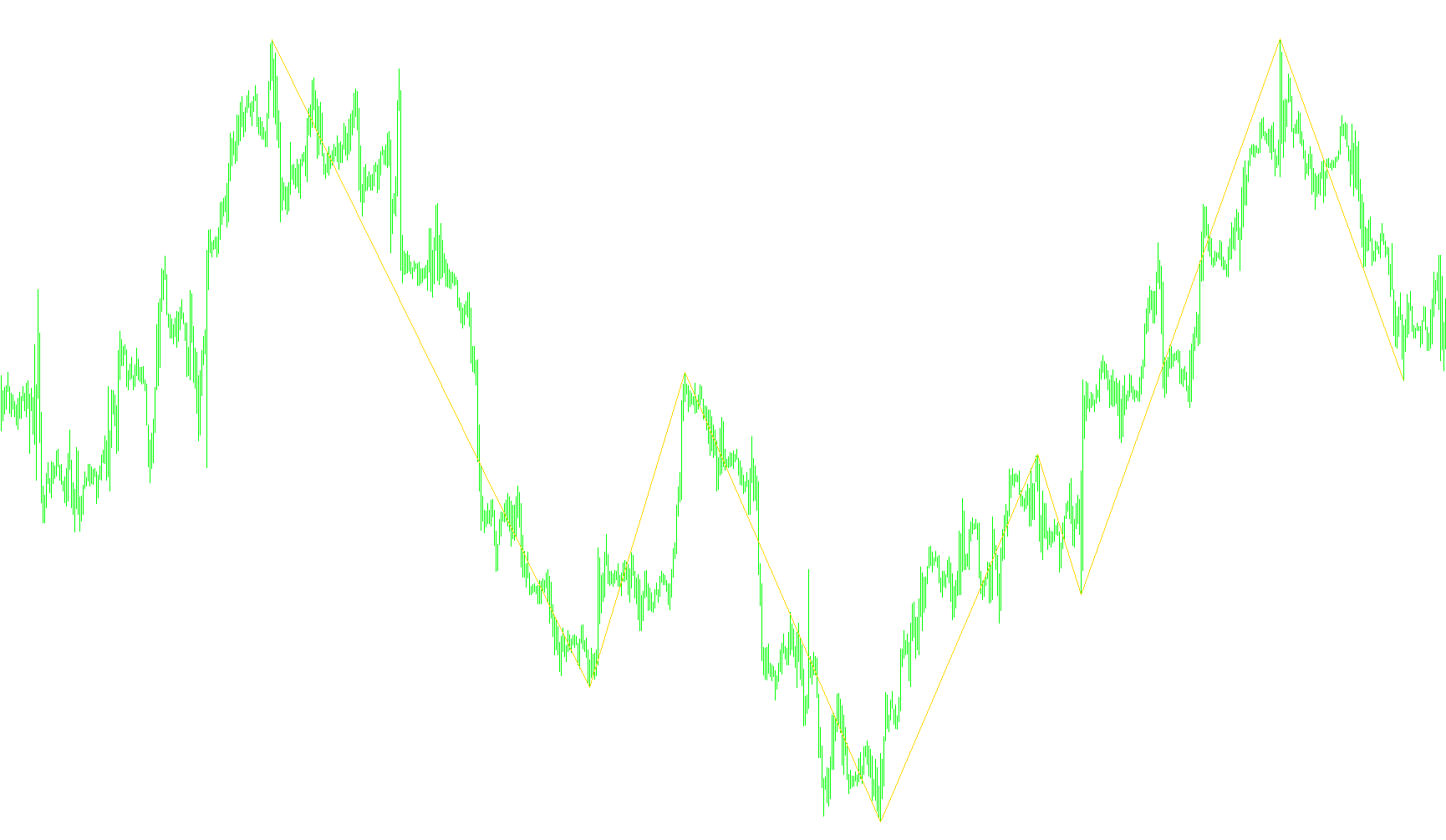
This script is designed to provide a visual representation of market trends by identifying significant price peaks and valleys, often referred to as a "ZigZag" pattern. Unlike standard indicators that might react to every minor price flicker, this tool uses sophisticated smoothing and filtering logic to ensure that only meaningful structural movements are highlighted on your chart.
Core Logic Overview
1. Advanced Trend Smoothing (Non-Lagging Moving Average) The foundation of this script is a specialized moving average calculation. Instead of simply averaging recent prices, it applies a unique mathematical weighting system. It balances historical data with current price action to create a "smooth" line that identifies the underlying direction of the market without the typical delay (lag) found in standard averages.
2. Volatility-Based Filtering To prevent the indicator from creating "noise" during sideways or choppy markets, the script calculates the volatility of the price. It looks at how much the moving average is fluctuating over a specific period and determines a dynamic threshold.
- If a price movement is smaller than this threshold, the script ignores it as minor market noise.
- If a movement exceeds this threshold, the script recognizes it as a significant change in trend.
3. Trend Direction Detection By comparing the current smoothed value against the previous one, the logic determines if the market is currently in an "Upward" or "Downward" phase. It switches these states only when the price move is large enough to break through the volatility filter mentioned above.
4. Peak and Valley Identification (ZigZag Construction) Once a trend direction is established, the script performs a search for extremes:
- In an Upward Trend: The logic actively looks for the highest point reached since the trend began.
- In a Downward Trend: The logic seeks out the lowest point reached since the trend started.
When the trend finally reverses (e.g., moving from an upward trend to a downward trend), the script "locks in" these extremes and draws a connecting line between them. This creates the characteristic ZigZag pattern, clearly showing you where major price pivots occurred while stripping away the minor fluctuations in between.
Summary of User Experience
For a trader, this means the chart will display a clean, simplified path of market structure. It filters out the "jitter" of the market to show you the high-level progress of the price, making it easier to identify whether the market is structurally moving higher or lower over time.
//+------------------------------------------------------------------+
//|                                              NonLagZigZag_v2.mq4 |
//|                                Copyright © 2006, TrendLaboratory |
//|            http://finance.groups.yahoo.com/group/TrendLaboratory |
//|                                   E-mail: igorad2003@yahoo.co.uk |
//+------------------------------------------------------------------+
#property copyright "Copyright © 2006, TrendLaboratory"
#property link      "http://finance.groups.yahoo.com/group/TrendLaboratory"


#property indicator_chart_window
#property indicator_buffers 1
#property indicator_color1 White
#property indicator_width1 2

//---- input parameters
extern int     Price          =    0;  //Apply to Price(0-Close;1-Open;2-High;3-Low;4-Median price;5-Typical price;6-Weighted Close)
extern int     Length         =   100;  //Period of NonLagMA
extern double  PctFilter      =    2;  //Dynamic filter in decimals

double ZZBuffer[];
double MABuffer[];
double trend[];
double Del[];
double AvgDel[];

int    ilow, ihigh, nlow, nhigh, prevnhigh,prevnlow, BarsBack;
double alfa[];
datetime lotime,hitime;
int    i, Phase, Len, Cycle=4, Back=0;
double Coeff, beta, t, Sum, Weight, g;
double pi = 3.1415926535;
//+------------------------------------------------------------------+
//| Custom indicator initialization function                         |
//+------------------------------------------------------------------+
  int init()
  {
   IndicatorBuffers(5);
   SetIndexStyle(0,DRAW_SECTION);
   SetIndexBuffer(0,ZZBuffer);
   SetIndexBuffer(1,MABuffer);
   SetIndexBuffer(2,trend);
   SetIndexBuffer(3,Del);
   SetIndexBuffer(4,AvgDel);
   string short_name;
//---- indicator line

   IndicatorDigits(MarketInfo(Symbol(),MODE_DIGITS));
//---- name for DataWindow and indicator subwindow label
   short_name="NonLagZigZag("+Length+")";
   IndicatorShortName(short_name);
   SetIndexLabel(0,"NonLagZigZag");
//----
   SetIndexEmptyValue(0,0.0);
   SetIndexDrawBegin(0,Length*Cycle+Length);
//----

   Coeff =  3*pi;
   Phase = Length-1;
   Len = Length*Cycle + Phase;
   ArrayResize(alfa,Len);
   Weight=0;

      for (i=0;i<Len-1;i++)
      {
      if (i<=Phase-1) t = 1.0*i/(Phase-1);
      else t = 1.0 + (i-Phase+1)*(2.0*Cycle-1.0)/(Cycle*Length-1.0);
      beta = MathCos(pi*t);
      g = 1.0/(Coeff*t+1);
      if (t <= 0.5 ) g = 1;
      alfa[i] = g * beta;
      Weight += alfa[i];
      }

   return(0);
  }

//+------------------------------------------------------------------+
//| NonLagZigZag_v2                                                  |
//+------------------------------------------------------------------+
int start()
{
   int    i,shift, counted_bars=IndicatorCounted(),limit;
   double price,smin,smax;
   if ( counted_bars > 0 )  limit=Bars-counted_bars;
   if ( counted_bars < 0 )  return(0);
   if ( counted_bars ==0 )  limit=Bars-1;
   if ( counted_bars < 1 )
   {
   for(i=0;i<Bars-1;i++)
   ZZBuffer[i]=0;
   for(i=1;i<Len;i++)
   MABuffer[Bars-i]=iMA(NULL,0,1,0,MODE_SMA,Price,Bars-i);
   }

   for(shift=limit;shift>=0;shift--)
   {
      Sum = 0;
      for (i=0;i<=Len-1;i++)
	   {
      price = iMA(NULL,0,1,0,3,Price,i+shift);
      Sum += alfa[i]*price;
      }

	if (Weight > 0) MABuffer[shift] = Sum/Weight;

   Del[shift] = MathAbs(MABuffer[shift] - MABuffer[shift+1]);

   double sumdel=0;
   for (i=0;i<=Length-1;i++) sumdel += Del[shift+i];

   AvgDel[shift] = sumdel/Length;

   double sumpow = 0;
   for (i=0;i<=Length-1;i++) sumpow += MathPow(Del[shift+i]-AvgDel[shift+i],2);
   double StdDev = MathSqrt(sumpow/Length);

   double Filter = PctFilter * StdDev;
   if (Filter < Point) Filter = Point;

   if( MathAbs(MABuffer[shift]-MABuffer[shift+1]) < Filter ) MABuffer[shift]=MABuffer[shift+1];

   trend[shift]=trend[shift+1];
   if (MABuffer[shift]-MABuffer[shift+1] > Filter) trend[shift]= 1;
   if (MABuffer[shift+1]-MABuffer[shift] > Filter) trend[shift]=-1;

      if(trend[shift]>0)
      {
         if( trend[shift]!=trend[shift+1])
         {
         ilow = LowestBar(iBarShift(NULL,0,hitime,FALSE)-shift,shift);
         lotime = Time[ilow];
         ZZBuffer[ilow] = Low[ilow];
         }
         else
         if (shift==0)
         {
         int hilen = iBarShift(NULL,0,lotime,FALSE);
         nhigh = HighestBar(hilen,0);
         ZZBuffer[nhigh]=High[nhigh];
         if (nhigh== 0) for (i=hilen-1;i>=1;i--) ZZBuffer[i]=0;
         if (nhigh > 0) for (i=nhigh-1;i>=0;i--) ZZBuffer[i]=0;
         }
      }

      if (trend[shift]<0)
      {
         if( trend[shift]!=trend[shift+1])
         {
         ihigh = HighestBar(iBarShift(NULL,0,lotime,FALSE)-shift,shift);
         hitime=Time[ihigh];
         ZZBuffer[ihigh] = High[ihigh];
         }
         else
         if (shift==0)
         {
         int lolen = iBarShift(NULL,0,hitime,FALSE);
         nlow = LowestBar(lolen,0);
         ZZBuffer[nlow] = Low[nlow];
         if (nlow==0) for (i=lolen-1;i>=1;i--) ZZBuffer[i]=0;
         if (nlow >0) for (i=nlow-1;i>=0;i--) ZZBuffer[i]=0;
         }
      }
   }
   return(0);
}

int LowestBar(int len,int k)
{
   double min = 10000000;
   int lobar;

   for (int i=k+len-1;i>=k;i--)
   if(Low[i] < min) {min = Low[i]; lobar = i;}
   if(len<=0) lobar=k;
   return(lobar);
}

int HighestBar(int len,int k)
{
   double max = -10000000;
   int hibar;

   for (int i=k+len-1;i>=k;i--)
   if(High[i] > max) {max = High[i]; hibar = i;}

   if(len<=0) hibar=k;
   return(hibar);
}
Comments