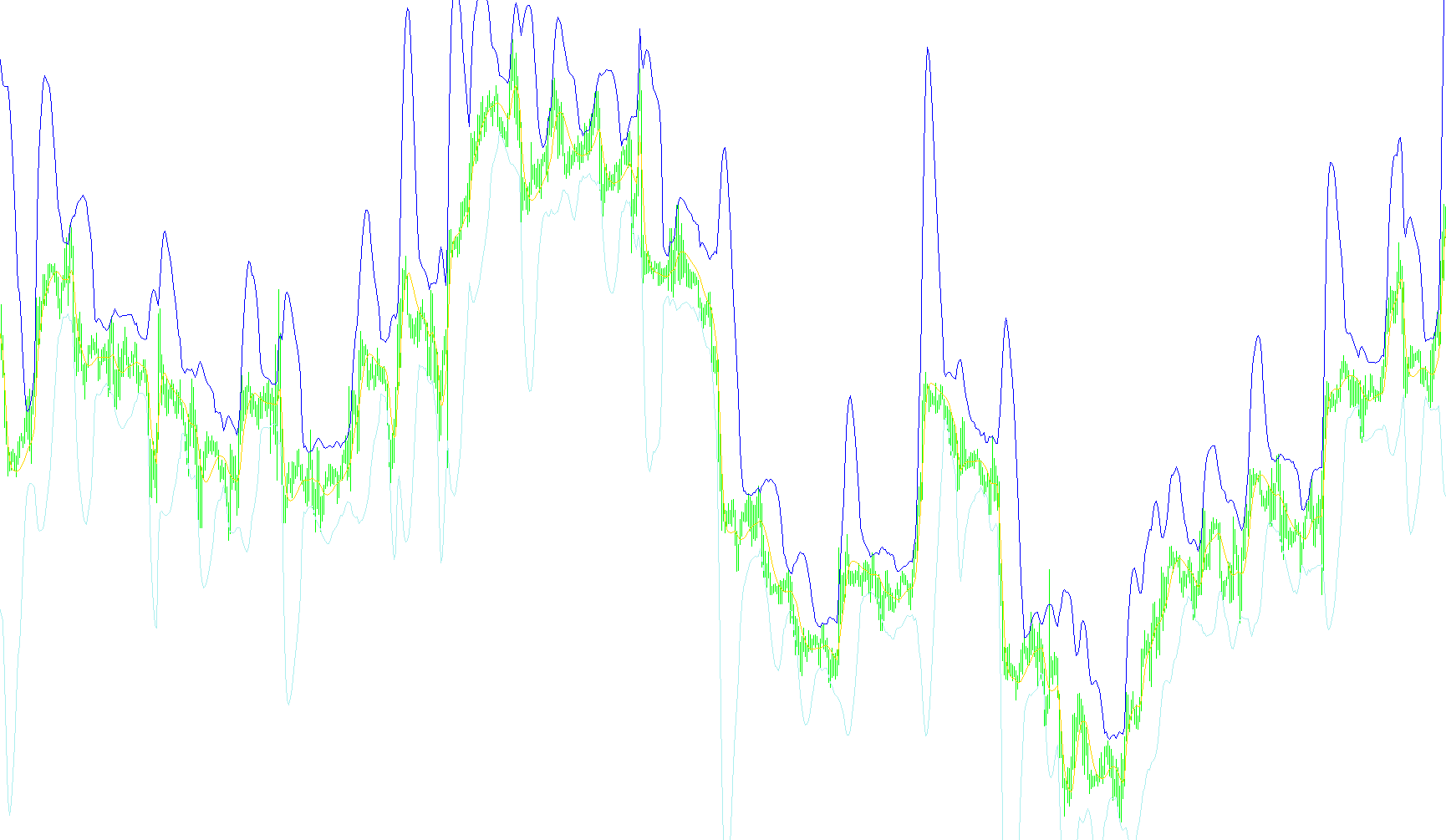
This script is designed to generate a dynamic technical analysis tool for trading charts, specifically creating a customized moving average system with volatility bands. Here is a breakdown of the logic used to create these visual elements:
Core Moving Average Logic (JMA)
The foundation of this script is a sophisticated "Jurik Moving Average" (JMA). Unlike standard moving averages that simply take an average of past prices, this logic is designed to reduce lag while maintaining smoothness. It achieves this through several complex steps:
- Adaptive Smoothing: The script uses advanced mathematical functions (including logarithms and square roots) to calculate how much weight to give to new price data versus old data. This allows the indicator to react quickly to sudden market shifts while remaining stable during periods of low volatility.
- Dynamic Weighting: It employs a "loop" system that evaluates the difference between current price action and historical extremes. By calculating these deviations, the script adjusts its internal "momentum" to ensure the resulting line follows the price curve as closely as possible without the typical "delay" seen in basic indicators.
- Phase and Length Customization: The user can adjust the "Length" (the lookback period) and the "Phase" (which affects the responsiveness). The logic takes these inputs to build a custom mathematical framework that dictates how aggressive or conservative the average should be.
Volatility Bands (JBands)
Once the core moving average is calculated, the script adds a second layer of logic to create "Bands"—similar to Bollinger Bands but based on the specialized JMA calculation mentioned above.
- Standard Deviation Calculation: The script looks at the price history over the specified "Length" and measures how much the price fluctuates away from the core average.
- Dynamic Upper and Lower Bounds: Using the "Deviations" input, the script calculates a margin of error. It adds this margin to the moving average to create an Upper Band and subtracts it to create a Lower Band.
- Visual Representation: These bands provide a visual "channel." When the price stays within these bands, the market is often considered to be in a normal state; when it breaks out significantly beyond them, it may indicate an overextended move or a trend reversal.
Summary of Visual Output
For the user watching the chart, the script produces three distinct lines:
- The Central Line (Orange): The smoothed JMA average, representing the "fair value" or trend direction.
- The Upper Band (Red): A dynamic ceiling based on price volatility.
- The Lower Band (Lime): A dynamic floor based on price volatility.
//+------------------------------------------------------------------+
//|                                                       JBands.mq4 |
//|                                              Federico Costalonga |
//|                                                                  |
//+------------------------------------------------------------------+
#property copyright "Federico Costalonga"
#property link      ""

#property indicator_chart_window
#property indicator_buffers 3
#property indicator_color1 Orange
#property indicator_color2 Red
#property indicator_color3 Lime
//---- input parameters
extern int       Length = 14;
extern int       Phase  = 0;
extern double    Deviations = 2.4;
//---- buffers
double JMAValueBuffer [], JMAUpperValueBuffer [], JMALowerValueBuffer [];
double fC0Buffer [];
double fA8Buffer [];
double fC8Buffer [];
double UpperBuffer [];
double LowerBuffer [];
double MovingBuffer [];
//---- temporary buffers
double list[128], ring1[128], ring2[11], buffer[62];
//---- bool flag
bool   initFlag;
//---- integer vars
int    limitValue, startValue, loopParam, loopCriteria;
int    cycleLimit, highLimit, counterA, counterB;
//---- double vars
double cycleDelta, lowDValue, highDValue, absValue, paramA, paramB;
double phaseParam, logParam, JMAValue, series, sValue, sqrtParam, lengthDivider;
//---- temporary int variables
int   s58, s60, s40, s38, s68;
//+------------------------------------------------------------------+
//| JMA initFlagization function                                     |
//+------------------------------------------------------------------+
int init()
  {
   double   lengthParam;
//---- 3 additional buffers are used for counting.
   IndicatorBuffers(6);
//---- drawing settings
   SetIndexStyle(0,DRAW_LINE);
   SetIndexBuffer(0,JMAValueBuffer);
   SetIndexStyle(1,DRAW_LINE);
   SetIndexBuffer(1,JMAUpperValueBuffer);
   SetIndexStyle(2,DRAW_LINE);
   SetIndexBuffer(2,JMALowerValueBuffer);
   SetIndexDrawBegin(0, Length);
   SetIndexDrawBegin(1, Length);
   SetIndexDrawBegin(2, Length);
//---- additional indicators buffers mapping
   SetIndexBuffer (3, fC0Buffer);
   SetIndexBuffer (4, fA8Buffer);
   SetIndexBuffer (5, fC8Buffer);
//---- initialize one buffer (neccessary)
   ArrayInitialize (ring2, 0);
   ArrayInitialize (ring1, 0);
   ArrayInitialize (buffer, 0);
//---- name for DataWindow and indicator subwindow label
   IndicatorShortName ("JBandsValue(" + Length + "," + Phase + "," + Deviations + ")");
   SetIndexLabel (0, "JBandsValue");
//---- initial part
   limitValue = 63;
   startValue = 64;
//----
   for (int i = 0; i <= limitValue; i++) list [i] = -1000000;
   for (i = startValue; i <= 127; i++)   list [i] = 1000000;
//----
   initFlag  = true;
   if (Length < 1.0000000002) lengthParam = 0.0000000001;
   else lengthParam = (Length - 1) / 2.0;
//----
   if (Phase < -100) phaseParam = 0.5;
   else if (Phase > 100) phaseParam = 2.5;
   else phaseParam = Phase / 100.0 + 1.5;
//----
   logParam = MathLog (MathSqrt (lengthParam)) / MathLog (2.0);
//----
   if (logParam + 2.0 < 0) logParam = 0;
   else logParam = logParam + 2.0;
//----
   sqrtParam     = MathSqrt(lengthParam) * logParam;
   lengthParam   = lengthParam * 0.9;
   lengthDivider = lengthParam / (lengthParam + 2.0);
//----
   return;
}
//+------------------------------------------------------------------+
//| JMA iteration function                                           |
//+------------------------------------------------------------------+
int start()
  {

   int    q,k;
   double deviation;
   double sum,oldval,newres;

//---- get already counted bars
   int counted_bars = IndicatorCounted();
//---- check for possible errors
   if (counted_bars < 0) return (-1);
   int limit = Bars - counted_bars - 1;
//---- main cycle
   for (int shift = limit; shift >= 0; shift--) {
      series = Close [shift];

      if (loopParam < 61) {
         loopParam++;
         buffer [loopParam] = series;
      }
      if (loopParam > 30) {
         if (initFlag) {
            initFlag = false;

            int diffFlag = 0;
            for (int i = 1; i <= 29; i++) {
               if (buffer [i + 1] != buffer [i]) diffFlag = 1;
            }
            highLimit = diffFlag * 30;

            if (highLimit == 0) paramB = series;
            else paramB = buffer[1];

            paramA = paramB;
            if (highLimit > 29) highLimit = 29;
         } else
            highLimit = 0;
//---- big cycle
         for (i = highLimit; i >= 0; i--) {
			   if (i == 0) sValue = series; else sValue = buffer [31 - i];

			   if (MathAbs (sValue - paramA) > MathAbs (sValue - paramB)) absValue = MathAbs(sValue - paramA); else absValue = MathAbs(sValue - paramB);
			   double dValue = absValue + 0.0000000001; //1.0e-10;

			   if (counterA <= 1) counterA = 127; else counterA--;
			   if (counterB <= 1) counterB = 10;  else counterB--;
			   if (cycleLimit < 128) cycleLimit++;
			   cycleDelta += (dValue - ring2 [counterB]);
			   ring2 [counterB] = dValue;
			   if (cycleLimit > 10) highDValue = cycleDelta / 10.0; else highDValue = cycleDelta / cycleLimit;

			   if (cycleLimit > 127) {
				   dValue = ring1 [counterA];
				   ring1 [counterA] = highDValue;
				   s68 = 64; s58 = s68;
				   while (s68 > 1) {
					   if (list [s58] < dValue) {
						   s68 = s68 / 2.0;
						   s58 += s68;
					   } else
					   if (list [s58] <= dValue) {
						   s68 = 1;
					   } else {
						   s68 = s68 / 2.0;
						   s58 -= s68;
					   }
               }
            } else {
			      ring1 [counterA] = highDValue;
			      if ((limitValue + startValue) > 127) {
				      startValue--;
				      s58 = startValue;
			      } else {
				      limitValue++;
				      s58 = limitValue;
			      }
			      if (limitValue > 96) s38 = 96; else s38 = limitValue;
			      if (startValue < 32) s40 = 32; else s40 = startValue;
		      }
//----
		      s68 = 64;
		      s60 = s68;
		      while (s68 > 1) {
			      if (list [s60] >= highDValue) {
				      if (list [s60 - 1] <= highDValue) {
					      s68 = 1;
				      }
				      else {
					      s68 = s68 / 2.0;
					      s60 -= s68;
				      }
			      }
			      else {
				      s68 = s68 / 2.0;
				      s60 += s68;
			      }
			      if ((s60 == 127) && (highDValue > list[127])) s60 = 128;
		      }
			   if (cycleLimit > 127) {
				   if (s58 >= s60) {
					   if (((s38 + 1) > s60) && ((s40 - 1) < s60))
						    lowDValue += highDValue;
					   else if ((s40 > s60) && ((s40 - 1) < s58))
						    lowDValue += list [s40 - 1];
				   }
				   else if (s40 >= s60) {
					   if (((s38 + 1) < s60) && ((s38 + 1) > s58))
							    lowDValue += list[s38 + 1];
					}
				   else if ((s38 + 2) > s60)
						   lowDValue += highDValue;
				   else if (((s38 + 1) < s60) && ((s38 + 1) > s58))
						   lowDValue += list[s38 + 1];

				   if (s58 > s60) {
					   if (((s40 - 1) < s58) && ((s38 + 1) > s58))
						   lowDValue -= list [s58];
					   else if ((s38 < s58) && ((s38 + 1) > s60))
						   lowDValue -= list [s38];
				   }
				   else {
					   if (((s38 + 1) > s58) && ((s40 - 1) < s58))
						   lowDValue -= list [s58];
					   else if ((s40 > s58) && (s40 < s60))
						   lowDValue -= list [s40];
				   }
			   }
			   if (s58 <= s60) {
				   if (s58 >= s60) list[s60] = highDValue; else {
					   for (int j = s58 + 1; j <= (s60 - 1); j++) {
						   list [j - 1] = list[j];
					   }
					   list [s60 - 1] = highDValue;
				   }
			   } else {
				   for (j = s58 - 1; j >= s60; j--) {
					   list [j + 1] = list [j];
				   }
				   list [s60] = highDValue;
			   }

			   if (cycleLimit <= 127) {
				   lowDValue = 0;
				   for (j = s40; j <= s38; j++) {
					   lowDValue += list[j];
				   }
			   }
//----
			   if ((loopCriteria + 1) > 31) loopCriteria = 31; else loopCriteria++;
			   double JMATempValue, sqrtDivider = sqrtParam / (sqrtParam + 1.0);

			   if (loopCriteria <= 30) {
				   if (sValue - paramA > 0) paramA = sValue; else paramA = sValue - (sValue - paramA) * sqrtDivider;
				   if (sValue - paramB < 0) paramB = sValue; else paramB = sValue - (sValue - paramB) * sqrtDivider;
				   JMATempValue = series;

				   if (loopCriteria == 30) {
				     fC0Buffer [shift] = series;
				     int intPart;

				     if (MathCeil(sqrtParam) >= 1) intPart = MathCeil(sqrtParam); else intPart = 1;
				     int leftInt = IntPortion (intPart);
				     if (MathFloor(sqrtParam) >= 1) intPart = MathFloor(sqrtParam); else intPart = 1;
				     int rightPart = IntPortion (intPart);

				     if (leftInt == rightPart) dValue = 1.0;
				     else
					     dValue = (sqrtParam - rightPart) / (leftInt - rightPart);

				     if (rightPart <= 29) int upShift = rightPart; else upShift = 29;
				     if (leftInt <= 29) int dnShift = leftInt; else dnShift = 29;
				     fA8Buffer [shift] = (series - buffer [loopParam - upShift]) * (1 - dValue) / rightPart + (series - buffer[loopParam - dnShift]) * dValue / leftInt;
               }
			   } else {
			      double powerValue, squareValue;

			      dValue = lowDValue / (s38 - s40 + 1);
			      if (0.5 <= logParam - 2.0) powerValue = logParam - 2.0;
               else powerValue = 0.5;

				   if (logParam >= MathPow(absValue/dValue, powerValue)) dValue = MathPow (absValue/dValue, powerValue); else dValue = logParam;
				   if (dValue < 1) dValue = 1;

				   powerValue = MathPow (sqrtDivider, MathSqrt (dValue));
				   if (sValue - paramA > 0) paramA = sValue; else paramA = sValue - (sValue - paramA) * powerValue;
				   if (sValue - paramB < 0) paramB = sValue; else paramB = sValue - (sValue - paramB) * powerValue;
   		   }
         }
// ---- end of big cycle
         if (loopCriteria > 30) {
				JMATempValue = JMAValueBuffer [shift + 1];
            powerValue   = MathPow (lengthDivider, dValue);
            squareValue  = MathPow (powerValue, 2);

				fC0Buffer [shift] = (1 - powerValue) * series + powerValue * fC0Buffer [shift + 1];
            fC8Buffer [shift] = (series - fC0Buffer [shift]) * (1 - lengthDivider) + lengthDivider * fC8Buffer [shift + 1];

            fA8Buffer [shift] = (phaseParam * fC8Buffer [shift] + fC0Buffer [shift] - JMATempValue) *
                                 (powerValue * (-2.0) + squareValue + 1) + squareValue * fA8Buffer [shift + 1];
            JMATempValue += fA8Buffer [shift];
         }
         JMAValue = JMATempValue;


      if (loopParam <= 30) JMAValue = 0;
      JMAValueBuffer [shift] = JMAValue;

     }


//---- End of main cycle

   }

//----

      for(q=0; q<limit; q++)
      MovingBuffer[q]=JMAValueBuffer[q];

      q=Bars-Length+1;
      if(counted_bars>Length-1) q=Bars-counted_bars-1;
      while(q>=0)
         {
         sum=0.0;
         k=q+Length-1;
         oldval=JMAValueBuffer[q];
         while(k>=q)
            {
            newres=Close[k]-oldval;
            sum+=newres*newres;
            k--;
            }
         deviation=Deviations*MathSqrt(sum/Length);
         JMAUpperValueBuffer[q]=oldval+deviation;
         JMALowerValueBuffer[q]=oldval-deviation;
         q--;
         }

  return;

  }

//+------------------------------------------------------------------+
int IntPortion (double param) {
   if (param > 0) return (MathFloor (param));
   if (param < 0) return (MathCeil (param));
   return (0.0);
}
//+------------------------------------------------------------------+
Comments