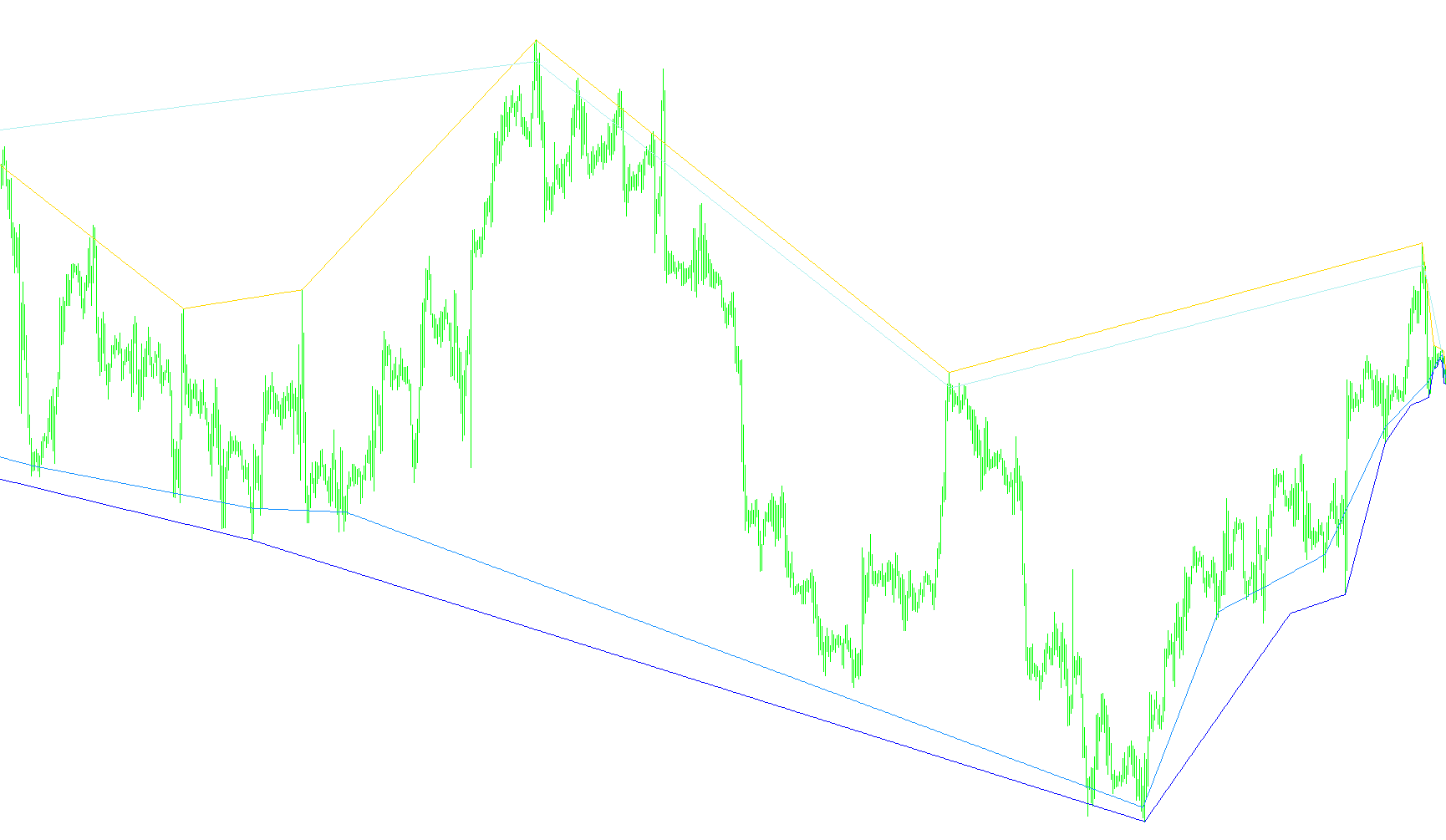
This script is a specialized technical analysis tool designed to visualize and smooth out price movements on a trading chart. Rather than simply showing the raw, jagged price action of every candle, this indicator identifies specific directional shifts in the market to create more streamlined visual trends.
Core Logic Overview
The script monitors four different data points simultaneously:
- High Prices: The highest point reached during each period.
- Low Prices: The lowest point reached during each period.
- Mid-Point Price A: An average of the opening and closing prices.
- Mid-Point Price B: Another instance of the average price used for parallel tracking.
How it Processes Data
The indicator operates by "scanning" past price history to detect changes in direction. Here is how it handles those movements:
- Trend Detection: The script looks for peaks and troughs. For example, when monitoring high prices, it watches for the moment the price stops falling and begins to rise.
- Point Identification: When a reversal occurs, the script identifies the "turning point" by calculating the midpoint between the previous low and the new high.
- Linear Smoothing: Once these pivot points are identified, the script applies a mathematical calculation to fill in the gaps between them. Instead of letting the line jump instantly from one point to another, it creates a diagonal connecting line. This simulates a smoother transition, making it easier for a trader to see the primary path of the market.
Visual Behavior
By applying this logic to both the highs and lows (as well as the mid-points), the script produces four distinct lines on your chart:
- Upper Bounds: These lines track the smoothed "ceiling" of the price action (Highs).
- Lower Bounds: These lines track the smoothed "floor" of the price action (Lows).
- Mid-Line Tracking: These lines provide a stabilized view of the internal price equilibrium.
Summary for the User
Essentially, this script acts as a "filter" for market noise. By identifying specific structural pivots and drawing linear paths between them, it helps you visualize whether the market is trending upward, downward, or moving sideways without being distracted by the small, erratic fluctuations of individual candles.
//+------------------------------------------------------------------+
//| H_L.mq4 |
//| Copyright © 2004, MetaQuotes Software Corp. |
//| http://www.metaquotes.net |
//+------------------------------------------------------------------+
#property copyright "Copyright © 2004, MetaQuotes Software Corp."
#property link "http://www.metaquotes.net"

#property indicator_chart_window
#property indicator_buffers 4
#property indicator_color1 Blue
#property indicator_color2 Blue
#property indicator_color3 Yellow
#property indicator_color4 Yellow
//---- input parameters
extern int S=4;
//---- buffers
double ID_0[];
double ID_1[];
double ID_2[];
double ID_3[];
//+------------------------------------------------------------------+
//| Custom indicator initialization function |
//+------------------------------------------------------------------+
int init()
{
IndicatorBuffers(4);
SetIndexBuffer(0,ID_0);
SetIndexBuffer(1,ID_1);
SetIndexBuffer(2,ID_2);
SetIndexBuffer(3,ID_3);
//---- indicators
SetIndexStyle(0,DRAW_LINE);
SetIndexStyle(1,DRAW_LINE);
SetIndexStyle(2,DRAW_LINE);
SetIndexStyle(3,DRAW_LINE);
//----//
return(0);
}
//+------------------------------------------------------------------+
//| Custom indicator deinitialization function |
//+------------------------------------------------------------------+
int deinit()
{
//---- TODO: add your code here

//----
return(0);
}
//+------------------------------------------------------------------+
//| Custom indicator iteration function |
//+------------------------------------------------------------------+
int start()
{
int limit;
int counted_bars=IndicatorCounted();
if (counted_bars<0) return (-1);
if (counted_bars>0) counted_bars--;
limit=Bars-counted_bars;
int A1=0;int A1d=0;
int A2=0;int A2d=0;
int V1=0;int V1d=0;
int V2=0;int V2d=0;
int AX=0;int AXd=0;
int BX=0;int BXd=0;
int CX=0;int CXd=0;
int DX=0;int DXd=0;

for (int cnt1=0; cnt1<limit; cnt1++)
{
ID_0[cnt1]=High[cnt1];
ID_1[cnt1]=Low[cnt1];
ID_2[cnt1]=(Open[cnt1]+Close[cnt1])/2;
ID_3[cnt1]=(Open[cnt1]+Close[cnt1])/2;
}
for (int cnt2=0;cnt2<S;cnt2++)
{
AX=0;BX=0;CX=0;DX=0;A1=0;A2=0;V1=0;V2=0;
AXd=0;BXd=0;CXd=0;DXd=0;A1d=0;A2d=0;V1d=0;V2d=0;

for (int cnt3=limit-1;cnt3>=0;cnt3--)
{//---------------------------------------------------
if (cnt3>0 && ID_0[cnt3]<ID_0[cnt3-1])
{
AX=cnt3-1;
BX=AX;
}
if (cnt3>0 && ID_0[cnt3]==ID_0[cnt3-1] && AX>0)
{
BX=cnt3-1;
}
if (cnt3>0 && ID_0[cnt3]>ID_0[cnt3-1] && AX>0) //
{
if (A1==0)
{
A1=(AX+BX)/2;
}
if (A1>0)
{
A2=(AX+BX)/2;
}
if (A1>0 && A2>0)
{
for (int cnt4=1;cnt4<=A1-A2;cnt4++)
{
ID_0[A2+cnt4]=ID_0[A2]+(((ID_0[A1]-ID_0[A2])*cnt4)/(A1-A2));
}
A1=A2;
A2=0;
}
}
//-----------------------------------------------
if (cnt3>0 && ID_1[cnt3]>ID_1[cnt3-1])
{
CX=cnt3-1;
DX=CX;
}
if (cnt3>0 && ID_1[cnt3]==ID_1[cnt3-1] && CX>0)
{
DX=cnt3-1;
}
if (cnt3>0 && ID_1[cnt3]<ID_1[cnt3-1] && CX>0)
{
if (V1==0)
{
V1=(CX+DX)/2;
}
if (V1>0)
{
V2=(CX+DX)/2;
}
if (V1>0 && V2>0)
{
for (int cnt5=1;cnt5<=V1-V2;cnt5++)
{
ID_1[V2+cnt5]=ID_1[V2]+(((ID_1[V1]-ID_1[V2])*cnt5)/(V1-V2));
}
V1=V2;
V2=0;
}
}
//---------------------------------------------------
//---------------------------------------------------
if (cnt3>0 && ID_2[cnt3]<ID_2[cnt3-1])
{
AXd=cnt3-1;
BXd=AXd;
}
if (cnt3>0 && ID_2[cnt3]==ID_2[cnt3-1] && AXd>0)
{
BXd=cnt3-1;
}
if (cnt3>0 && ID_2[cnt3]>ID_2[cnt3-1] && AXd>0)
{
if (A1d==0)
{
A1d=(AXd+BXd)/2;
}
if (A1d>0)
{
A2d=(AXd+BXd)/2;
}
if (A1d>0 && A2d>0)
{
for (int cnt41=1;cnt41<=A1d-A2d;cnt41++)
{
ID_2[A2d+cnt41]=ID_2[A2d]+(((ID_2[A1d]-ID_2[A2d])*cnt41)/(A1d-A2d));
}
A1d=A2d;
A2d=0;
}
}
//-----------------------------------------------
if (cnt3>0 && ID_3[cnt3]>ID_3[cnt3-1])
{
CXd=cnt3-1;
DXd=CXd;
}
if (cnt3>0 && ID_3[cnt3]==ID_3[cnt3-1] && CXd>0)
{
DXd=cnt3-1;
}
if (cnt3>0 && ID_3[cnt3]<ID_3[cnt3-1] && CXd>0)
{
if (V1d==0)
{
V1d=(CXd+DXd)/2;
}
if (V1d>0)
{
V2d=(CXd+DXd)/2;
}
if (V1d>0 && V2d>0)
{
for (int cnt51=1;cnt51<=V1d-V2d;cnt51++)
{
ID_3[V2d+cnt51]=ID_3[V2d]+(((ID_3[V1d]-ID_3[V2d])*cnt51)/(V1d-V2d));
}
V1d=V2d;
V2d=0;
}
}
}//-----------------------------------------------------
}

return(0);
}
Comments