ADX_WildersDMI_v1m_v1
Download script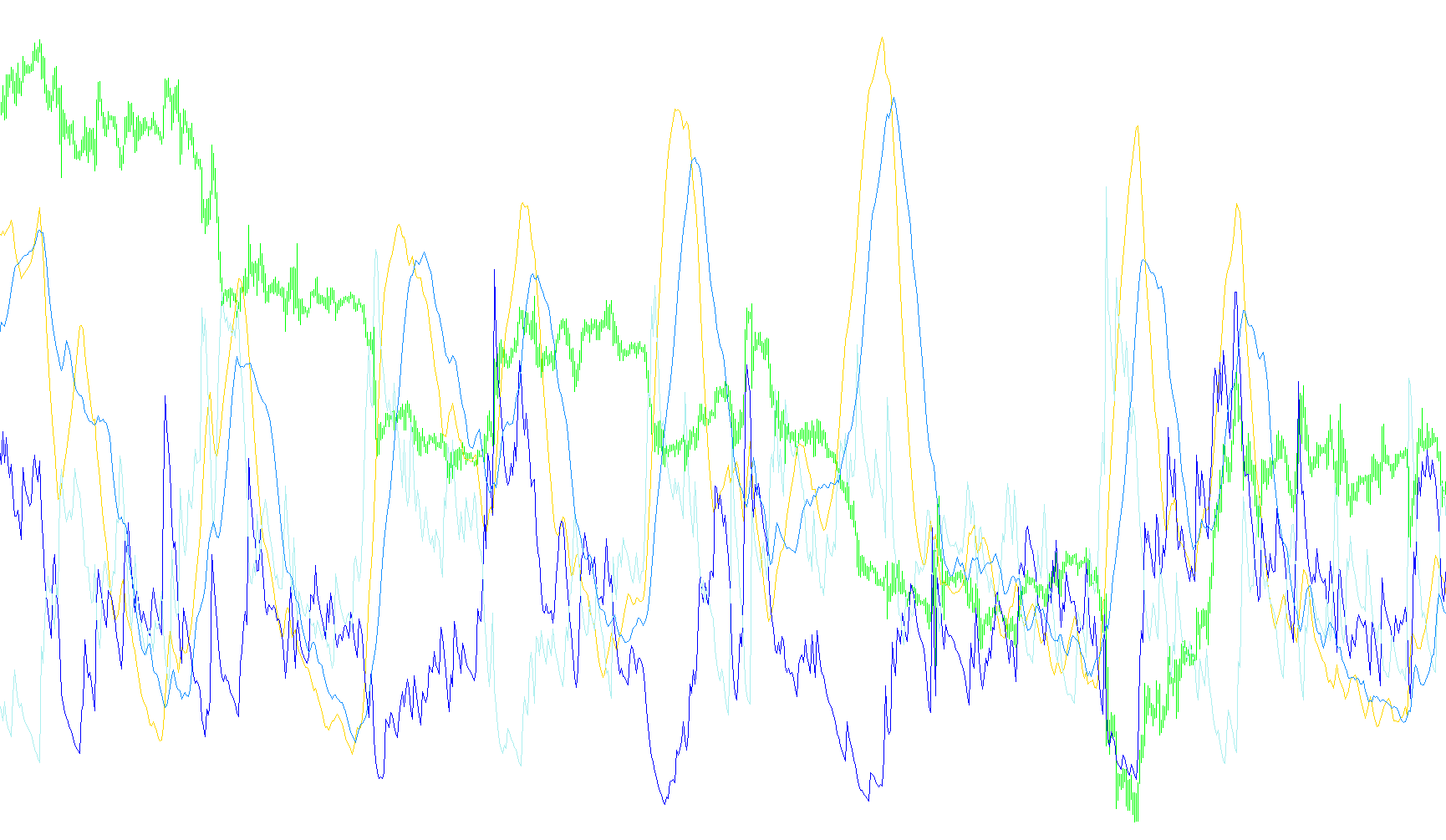
This script is a custom technical analysis tool designed to help traders identify and measure market trends, the strength of those trends, and the direction of price movement. It uses a refined version of the "Directional Movement Index" (DMI) logic, which focuses on distinguishing between upward and downward momentum.
Here is a breakdown of how the logic functions:
Core Mechanism: Tracking Price Movement
The tool works by analyzing the difference between current price highs and lows compared to previous ones. Instead of just looking at raw price, it looks for "true" movement:
- Bullish Movement: It identifies when current highs are higher than previous highs.
- Bearish Movement: It identifies when current lows are lower than previous lows.
- Filtering: The logic is designed to ignore movements where the price simply retreats without creating new extremes, focusing only on the "expansion" of the price range.
Key Components of the Analysis
The script calculates four primary metrics to give a complete picture of the market:
- The Plus Directional Index (+DI): This tracks the strength of upward momentum. When this value rises significantly, it suggests that buyers are pushing the price higher.
- The Minus Directional Index (-DI): This tracks the strength of downward momentum. A rise in this value indicates that sellers are gaining control and driving prices lower.
- Average Directional Index (ADX): This is a "trend strength" indicator. It doesn't tell you if the price is going up or down; rather, it tells you how powerful the current move is. A high ADX suggests a strong trending market, while a low ADX suggests a sideways or "choppy" market.
- ADXR: This provides a smoothed version of the ADX, helping to filter out minor fluctuations and provide a clearer view of long-term trend stability.
Smoothing and Calculation Logic
To ensure the data is easy for a human to read and not overly reactive to every tiny price tick, the script employs "smoothing." It uses specific mathematical weights (alphas) based on user-defined periods. This means the indicators react progressively to new data rather than jumping erratically, making it much more reliable for identifying sustained trends rather than temporary noise.
Summary for the Trader
When using this tool, you are essentially looking at a "tug-of-war" between buyers and sellers:
- By comparing +DI and -DI, you can see which side is winning.
- By observing the ADX, you can determine if that "win" is part of a powerful, high-momentum trend or just a minor fluctuation in a quiet market.
//+------------------------------------------------------------------+
//|                                                WildersDMI_v1.mq4 |
//|                           Copyright © 2007, TrendLaboratory Ltd. |
//|            http://finance.groups.yahoo.com/group/TrendLaboratory |
//|                                       E-mail: igorad2004@list.ru |
//+------------------------------------------------------------------+
#property copyright "Copyright © 2007, TrendLaboratory Ltd."
#property link      "http://finance.groups.yahoo.com/group/TrendLaboratory"
//----
#property indicator_separate_window
#property indicator_buffers   4
#property indicator_color1    LightBlue
#property indicator_width1    2
#property indicator_color2    Lime
#property indicator_width2    1
#property indicator_style2    2
#property indicator_color3    Tomato
#property indicator_width3    1
#property indicator_style3    2
#property indicator_color4    Orange
#property indicator_width4    2
#property indicator_level1    20
//---- input parameters
extern int       MA_Length  =1; // Period of additional smoothing
extern int       DMI_Length  =14; // Period of DMI
extern int       ADX_Length  =14; // Period of ADX
extern int       ADXR_Length =14; // Period of ADXR
extern int       UseADX     =1; // Use ADX: 0-off,1-on
extern int       UseADXR    =1; // Use ADXR: 0-off,1-on
//---- buffers
double ADX[];
double PDI[];
double MDI[];
double ADXR[];
double sPDI[];
double sMDI[];
double STR[];
double DX[];
//+------------------------------------------------------------------+
//| Custom indicator initialization function                         |
//+------------------------------------------------------------------+
int init()
  {
//---- indicators
   IndicatorBuffers(8);
   SetIndexStyle(0,DRAW_LINE);
   SetIndexBuffer(0,ADX);
   SetIndexStyle(1,DRAW_LINE);
   SetIndexBuffer(1,PDI);
   SetIndexStyle(2,DRAW_LINE);
   SetIndexBuffer(2,MDI);
   SetIndexStyle(3,DRAW_LINE);
   SetIndexBuffer(3,ADXR);
   SetIndexBuffer(4,sPDI);
   SetIndexBuffer(5,sMDI);
   SetIndexBuffer(6,STR);
   SetIndexBuffer(7,DX);
//---- name for DataWindow and indicator subwindow label
   string short_name="WildersDMI("+MA_Length+","+DMI_Length+","+ADX_Length+","+ADXR_Length+")";
   IndicatorShortName(short_name);
   SetIndexLabel(0,"ADX");
   SetIndexLabel(1,"+DI");
   SetIndexLabel(2,"-DI");
   SetIndexLabel(3,"ADXR");
//----
   SetIndexDrawBegin(0,DMI_Length+MA_Length);
   SetIndexDrawBegin(1,DMI_Length+MA_Length);
   SetIndexDrawBegin(2,DMI_Length+MA_Length);
   SetIndexDrawBegin(3,DMI_Length+MA_Length);
   SetIndexShift(3,2);
//----
   return(0);
  }
//+------------------------------------------------------------------+
//| Custom indicator iteration function                              |
//+------------------------------------------------------------------+
int start()
  {
   int      shift, limit, counted_bars=IndicatorCounted();
   double alfa1=1.0/DMI_Length;
   double alfa2=1.0/ADX_Length;
//----
   if (counted_bars < 0) return(-1);
   if(counted_bars<1)
      for(shift=1;shift<=MA_Length+DMI_Length;shift++)
        {
         PDI[Bars-shift]=0.0;MDI[Bars-shift]=0.0;ADX[Bars-shift]=0.0;
         sPDI[Bars-shift]=0.0;sMDI[Bars-shift]=0.0;DX[Bars-shift]=0.0;
         STR[Bars-shift]=0.0;ADXR[Bars-shift]=0.0;
        }
   shift=Bars-MA_Length-DMI_Length-1;
   if(counted_bars>=DMI_Length+MA_Length) shift=Bars-counted_bars-1;
   while(shift>=0)
     {
      double AvgHigh =iMA(NULL,0,MA_Length,0,1,PRICE_HIGH,shift);
      double AvgHigh1=iMA(NULL,0,MA_Length,0,1,PRICE_HIGH,shift+1);
      double AvgLow  =iMA(NULL,0,MA_Length,0,1,PRICE_LOW,shift);
      double AvgLow1 =iMA(NULL,0,MA_Length,0,1,PRICE_LOW,shift+1);
      double AvgClose1= iMA(NULL,0,MA_Length,0,1,PRICE_CLOSE,shift+1);
//----
      double Bulls=0.5*(MathAbs(AvgHigh-AvgHigh1)+(AvgHigh-AvgHigh1));
      double Bears=0.5*(MathAbs(AvgLow1-AvgLow)+(AvgLow1-AvgLow));
      if (Bulls > Bears) Bears=0;
      else
         if (Bulls < Bears) Bulls=0;
         else
            if (Bulls==Bears) {Bulls=0;Bears=0;}
//----
      sPDI[shift]=sPDI[shift+1] + alfa1 * (Bulls - sPDI[shift+1]);
      sMDI[shift]=sMDI[shift+1] + alfa1 * (Bears - sMDI[shift+1]);
//----
      double   TR=MathMax(AvgHigh-AvgLow,AvgHigh-AvgClose1);
      STR[shift] =STR[shift+1] + alfa1 * (TR - STR[shift+1]);
      if(STR[shift]>0 )
        {
         PDI[shift]=100*sPDI[shift]/STR[shift];
         MDI[shift]=100*sMDI[shift]/STR[shift];
        }
      if(UseADX > 0)
        {
         if((PDI[shift] + MDI[shift])>0)
            DX[shift]=100*MathAbs(PDI[shift] - MDI[shift])/(PDI[shift] + MDI[shift]);
         else DX[shift]=0;
//----
         ADX[shift]=ADX[shift+1] + alfa2 *(DX[shift] - ADX[shift+1]);
         if(UseADXR >0) ADXR[shift]=0.5*(ADX[shift] + ADX[shift+ADXR_Length]);
        }
      shift--;
     }
//----
   return(0);
  }
//+------------------------------------------------------------------+
Comments