VoltyChoppy_v1
Download script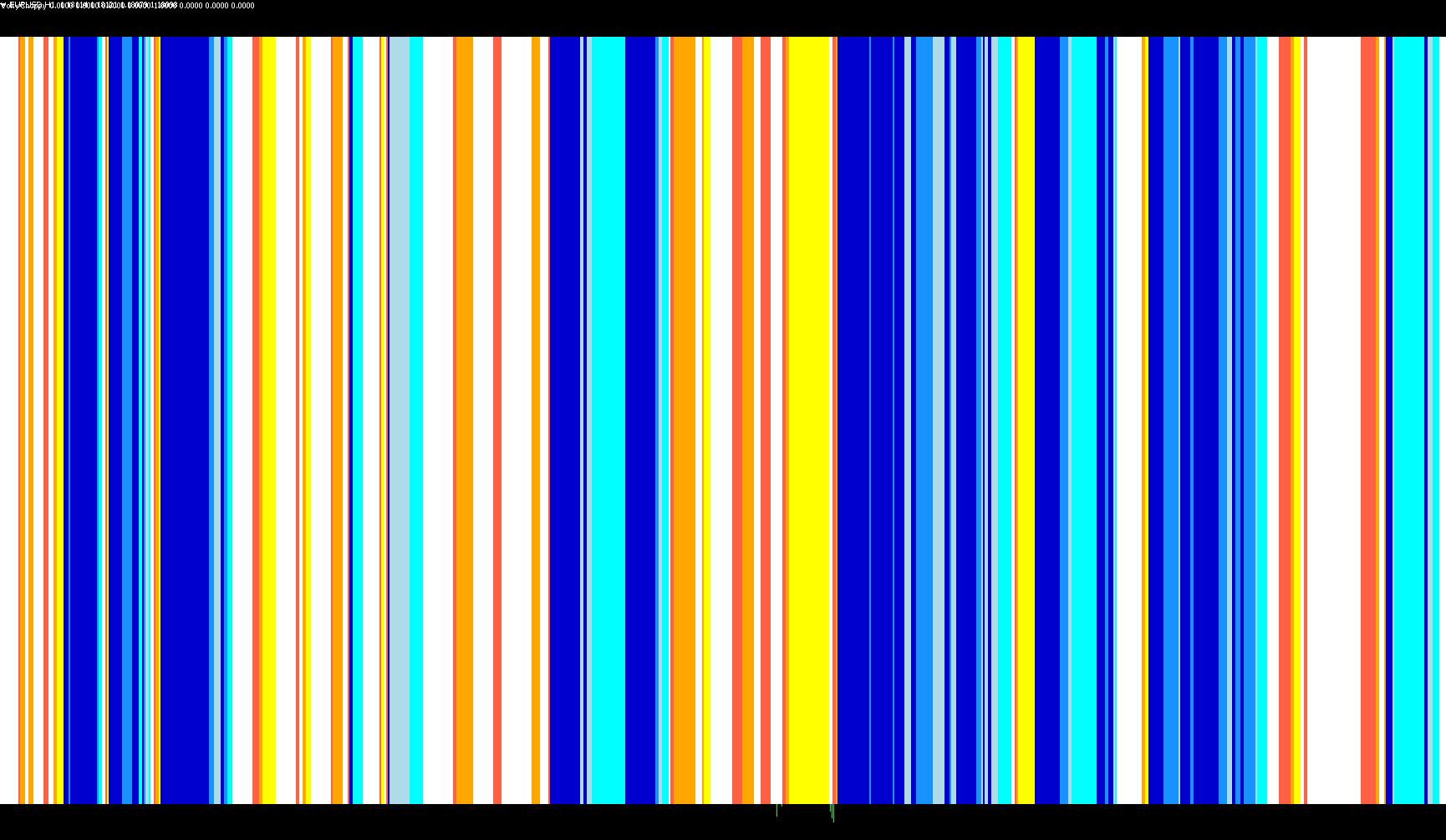
The VoltyChoppy indicator is designed to help traders visualize market dynamics by categorizing price action into different intensity levels. Rather than just showing a simple "up" or "down" direction, it analyzes the relationship between current price movement and historical volatility to determine how "strong" or "choppy" a trend actually is.
How the Logic Works
The script operates by creating four distinct categories for both upward and downward movements. It achieves this by calculating dynamic boundaries based on an Average True Range (ATR)—a standard measure of market volatility. By applying different mathematical multipliers to these boundaries, the tool can distinguish between various types of market behavior:
1. Trend Strength Analysis The indicator looks at where the current price sits relative to several layers of volatility bands. It essentially asks: Is the price moving significantly further than usual, or is it just drifting along?
- Strong Trends: When the price breaks significantly outside the primary volatility boundaries, it signals a powerful, high-momentum move.
- Retraces: If the price remains within a secondary boundary, it suggests the market is taking a breather or "pulling back" before continuing the main move.
- Choppy Movement: If the price stays within a tighter, more restricted zone, it indicates low-momentum "choppiness," where the market is struggling to establish a clear direction.
- Transition Alerts: The final category identifies when the price is nearing the edge of its current behavior, signaling that the current trend may be about to shift or lose steam.
Visual Representation
The logic translates these calculations into a color-coded histogram in a separate window:
- Blue Shading (Upward Bias): Ranges from deep blue (Strong UpTrend) to light aqua (Ready to change), showing the progression of bullish momentum.
- Red/Yellow Shading (Downward Bias): Ranges from deep crimson (Strong DownTrend) to bright yellow (Ready to change), showing the progression of bearish momentum.
Summary for the Trader
Instead of providing a simple buy or sell signal, this tool provides context. It helps you identify whether you are entering a market with high-velocity strength, a potential trend reversal, or a stagnant, choppy environment where traditional trend-following strategies might fail.
//+------------------------------------------------------------------+
//|                                               VoltyChoppy_v1.mq4 |
//|                                  Copyright © 2006, Forex-TSD.com |
//|                         Written by IgorAD,igorad2003@yahoo.co.uk |
//|            http://finance.groups.yahoo.com/group/TrendLaboratory |
//+------------------------------------------------------------------+
#property copyright "Copyright © 2006, Forex-TSD.com "
#property link      "http://www.forex-tsd.com/"

#property indicator_separate_window
#property indicator_minimum -0.05
#property indicator_maximum 1.05
#property indicator_buffers 8

//---- input parameters
extern int     Length      = 10;
extern double  Kv          = 4.0;
//extern double  Kd          = 1.1;
extern int     NumBars     = 1000;
//---- buffers
double UpBuffer1[];
double UpBuffer2[];
double UpBuffer3[];
double UpBuffer4[];

double DnBuffer1[];
double DnBuffer2[];
double DnBuffer3[];
double DnBuffer4[];

//+------------------------------------------------------------------+
//| Custom indicator initialization function                         |
//+------------------------------------------------------------------+
int init()
  {

//----
   SetIndexStyle(0,DRAW_HISTOGRAM,0,3,MediumBlue);
   SetIndexStyle(1,DRAW_HISTOGRAM,0,3,DodgerBlue);
   SetIndexStyle(2,DRAW_HISTOGRAM,0,3,LightBlue);
   SetIndexStyle(3,DRAW_HISTOGRAM,0,3,Aqua);

   SetIndexStyle(4,DRAW_HISTOGRAM,0,3,Crimson);
   SetIndexStyle(5,DRAW_HISTOGRAM,0,3,Tomato);
   SetIndexStyle(6,DRAW_HISTOGRAM,0,3,Orange);
   SetIndexStyle(7,DRAW_HISTOGRAM,0,3,Yellow);

   SetIndexBuffer(0,UpBuffer1);
   SetIndexBuffer(1,UpBuffer2);
   SetIndexBuffer(2,UpBuffer3);
   SetIndexBuffer(3,UpBuffer4);

   SetIndexBuffer(4,DnBuffer1);
   SetIndexBuffer(5,DnBuffer2);
   SetIndexBuffer(6,DnBuffer3);
   SetIndexBuffer(7,DnBuffer4);

//----
   string short_name="VoltyChoppy";
   IndicatorShortName(short_name);
   SetIndexLabel(0,"Strong UpTrend");
   SetIndexLabel(1,"Retrace UpTrend");
   SetIndexLabel(2,"Choppy UpTrend");
   SetIndexLabel(3,"Be ready to change UpTrend");

   SetIndexLabel(4,"Strong DownTrend");
   SetIndexLabel(5,"Retrace DownTrend");
   SetIndexLabel(6,"Choppy DownTrend");
   SetIndexLabel(7,"Be ready to change DownTrend");
//----

   SetIndexDrawBegin(0,Length);
   SetIndexDrawBegin(1,Length);
   SetIndexDrawBegin(2,Length);
   SetIndexDrawBegin(3,Length);
   SetIndexDrawBegin(4,Length);
   SetIndexDrawBegin(5,Length);
   SetIndexDrawBegin(6,Length);
   SetIndexDrawBegin(7,Length);
//----
   return(0);
  }
//+------------------------------------------------------------------+
//| VoltyChoppy_v1                                                  |
//+------------------------------------------------------------------+
int start()
  {
   double smin,smax,smin1,smax1,
          rmin,rmax,rmin1,rmax1,
          cmin,cmax,cmin1,cmax1,
          bmin,bmax,bmin1,bmax1;
   int    i, strend, rtrend, ctrend, btrend;

//----
   if(NumBars<=Length) return(0);
//---- initial zero
      for(i=NumBars;i>=0;i--)
      {
      UpBuffer1[i]=0.0;
      UpBuffer2[i]=0.0;
      UpBuffer3[i]=0.0;
      UpBuffer4[i]=0.0;

      DnBuffer1[i]=0.0;
      DnBuffer2[i]=0.0;
      DnBuffer3[i]=0.0;
      DnBuffer4[i]=0.0;
      }
//----
   double Kd = MathPow(Kv,1.0/3.0);

   for(i=NumBars - Length -1;i>=0;i--)
   {
   smin  = Close[i] - Kv*iATR(NULL,0,Length,i);
   smax  = Close[i] + Kv*iATR(NULL,0,Length,i);

   rmin  = Close[i] - Kv*iATR(NULL,0,Length,i)/Kd;
   rmax  = Close[i] + Kv*iATR(NULL,0,Length,i)/Kd;

   cmin  = Close[i] - Kv*iATR(NULL,0,Length,i)/(Kd*Kd);
   cmax  = Close[i] + Kv*iATR(NULL,0,Length,i)/(Kd*Kd);

   bmin  = Close[i] - Kv*iATR(NULL,0,Length,i)/(Kd*Kd*Kd);
   bmax  = Close[i] + Kv*iATR(NULL,0,Length,i)/(Kd*Kd*Kd);

   if ( Close[i] > smax1 ) strend = 1;
   if ( Close[i] < smin1 ) strend =-1;

   if ( strend > 0 && smin < smin1 ) smin = smin1;
   if ( strend < 0 && smax > smax1 ) smax = smax1;

   if ( Close[i] > rmax1 ) rtrend = 1;
   if ( Close[i] < rmin1 ) rtrend =-1;

   if ( rtrend > 0 && rmin < rmin1 ) rmin = rmin1;
   if ( rtrend < 0 && rmax > rmax1 ) rmax = rmax1;


   if ( Close[i] > cmax1 ) ctrend = 1;
   if ( Close[i] < cmin1 ) ctrend =-1;

   if ( ctrend > 0 && cmin < cmin1 ) cmin = cmin1;
   if ( ctrend < 0 && cmax > cmax1 ) cmax = cmax1;

   if ( Close[i] > bmax1 ) btrend = 1;
   if ( Close[i] < bmin1 ) btrend =-1;

   if ( btrend > 0 && bmin < bmin1 ) bmin = bmin1;
   if ( btrend < 0 && bmax > bmax1 ) bmax = bmax1;

   if ( strend  > 0 )
   {
    UpBuffer1[i] = 1.0;UpBuffer2[i] = 0.0;UpBuffer3[i] = 0.0;UpBuffer4[i] = 0.0;
    DnBuffer1[i] = 0.0;DnBuffer2[i] = 0.0;DnBuffer3[i] = 0.0;DnBuffer4[i] = 0.0;

   if ( btrend < 0 )
   {UpBuffer1[i] = 0.0;UpBuffer2[i] = 1.0;UpBuffer3[i] = 0.0;UpBuffer4[i] = 0.0;
    DnBuffer1[i] = 0.0;DnBuffer2[i] = 0.0;DnBuffer3[i] = 0.0;DnBuffer4[i] = 0.0;}

   if ( ctrend < 0 )
   {UpBuffer1[i] = 0.0;UpBuffer2[i] = 0.0;UpBuffer3[i] = 1.0;UpBuffer4[i] = 0.0;
    DnBuffer1[i] = 0.0;DnBuffer2[i] = 0.0;DnBuffer3[i] = 0.0;DnBuffer4[i] = 0.0;}

   if ( rtrend < 0 )
   {UpBuffer1[i] = 0.0;UpBuffer2[i] = 0.0;UpBuffer3[i] = 0.0;UpBuffer4[i] = 1.0;
    DnBuffer1[i] = 0.0;DnBuffer2[i] = 0.0;DnBuffer3[i] = 0.0;DnBuffer4[i] = 0.0;}
   }

   if ( strend < 0 )
   {
    UpBuffer1[i] = 0.0;UpBuffer2[i] = 0.0;UpBuffer3[i] = 0.0;UpBuffer4[i] = 0.0;
    DnBuffer1[i] = 1.0;DnBuffer2[i] = 0.0;DnBuffer3[i] = 0.0;DnBuffer4[i] = 0.0;

   if ( btrend > 0 )
   {UpBuffer1[i] = 0.0;UpBuffer2[i] = 0.0;UpBuffer3[i] = 0.0;UpBuffer4[i] = 0.0;
    DnBuffer1[i] = 0.0;DnBuffer2[i] = 1.0;DnBuffer3[i] = 0.0;DnBuffer4[i] = 0.0;}

   if ( ctrend > 0 )
   {UpBuffer1[i] = 0.0;UpBuffer2[i] = 0.0;UpBuffer3[i] = 0.0;UpBuffer4[i] = 0.0;
    DnBuffer1[i] = 0.0;DnBuffer2[i] = 0.0;DnBuffer3[i] = 1.0;DnBuffer4[i] = 0.0;}

   if ( rtrend > 0 )
   {UpBuffer1[i] = 0.0;UpBuffer2[i] = 0.0;UpBuffer3[i] = 0.0;UpBuffer4[i] = 0.0;
    DnBuffer1[i] = 0.0;DnBuffer2[i] = 0.0;DnBuffer3[i] = 0.0;DnBuffer4[i] = 1.0;}
   }

   smin1 = smin; smax1 = smax;
   rmin1 = rmin; rmax1 = rmax;
   cmin1 = cmin; cmax1 = cmax;
   bmin1 = bmin; bmax1 = bmax;


   }


//----
   return(0);
  }
//+------------------------------------------------------------------+
Comments