RMI(L)
Download script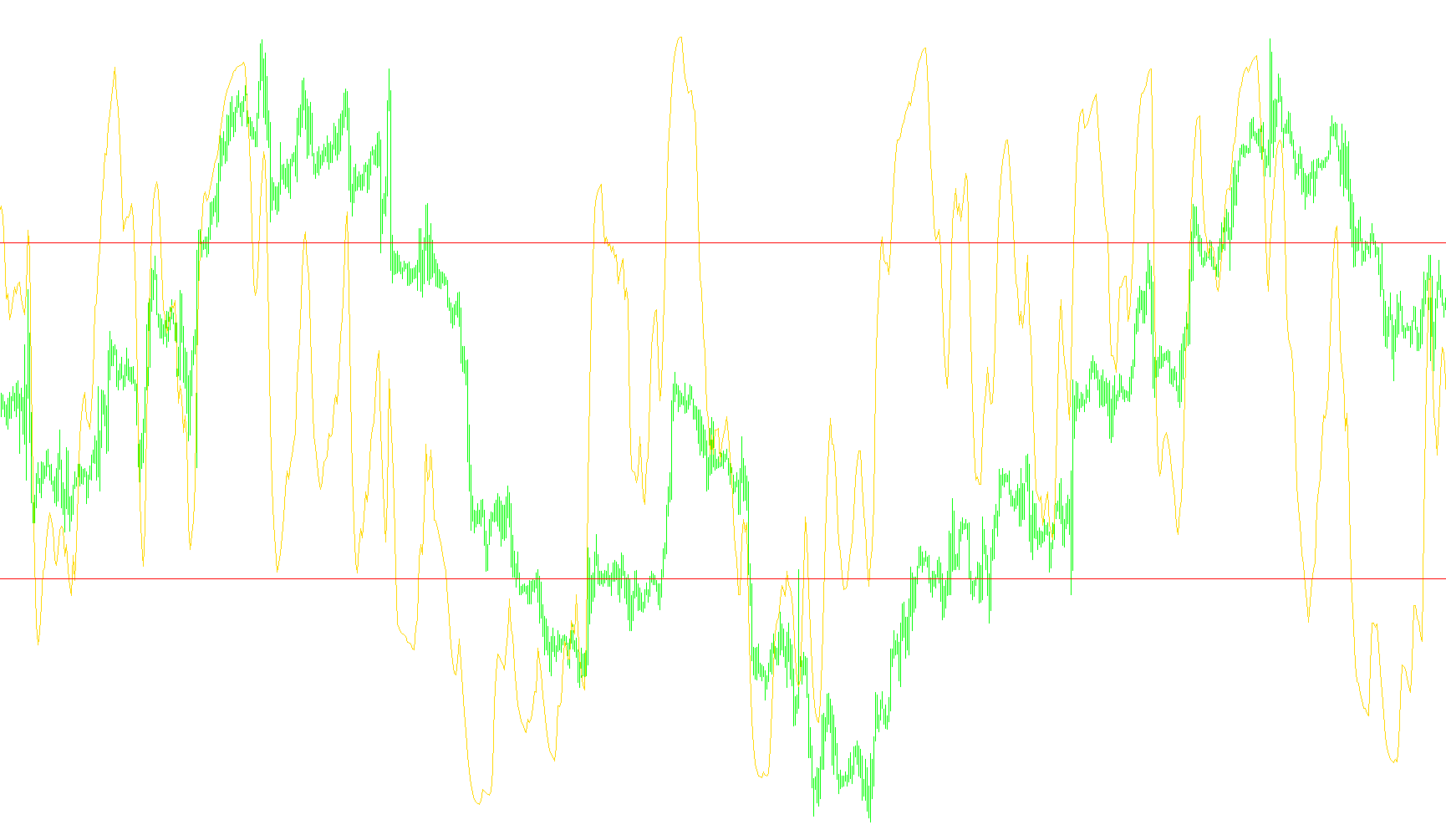
The Relative Momentum Index (RMI) is a specialized technical analysis tool designed to measure the strength and direction of price momentum. While it shares similarities with other popular indicators like the RSI, it offers a more nuanced look at market trends by adjusting how it calculates price changes over specific periods.
Core Logic and Functionality
Unlike standard momentum indicators that only look at the change between one candle and the next, the RMI looks at the difference between the current price and a price from a set number of days or bars ago (the "Momentum Period").
The logic follows these primary steps:
- Capturing Momentum: The script calculates the price difference over a chosen timeframe. If the price has increased relative to its past position, that "positive" movement is recorded; if it has decreased, the "negative" movement is noted.
- Smoothing the Data: Rather than providing erratic jumps in data, the script uses a moving average calculation. It takes the current momentum and blends it with previous values. This creates a smoother line on your chart, making it easier to identify consistent trends rather than temporary market noise.
- The Percentage Scale: The final output is expressed as a percentage (0 to 100). By dividing the total positive momentum by the sum of both positive and negative momentum, the script produces a standardized index. This allows traders to see exactly how dominant one direction is compared to the other.
How to Interpret the Results
The RMI functions as an "oscillator," meaning its movements tell you about the "heat" of the market:
- Overbought and Oversold Zones: The script establishes specific boundaries—typically 70 for "overbought" and 30 for "oversold." In a non-trending market, these levels help identify when an asset might be stretched too far in one direction and due for a correction.
- Trend Strength: If the indicator remains consistently high (near 70–90) or low (near 10–30) for a long time, it signals a very strong prevailing trend.
- Adjustable Sensitivity: By changing the parameters, you can control how "reactive" the tool is. A shorter period will make the line more sensitive to sudden price spikes, while a longer period creates a smoother line that focuses on long-term momentum shifts.
Miscellaneous
15
Views
0
Downloads
0
Favorites
RMI(L)
//+-------------------------------------------------------------------+
//|                                       Relative Momentum Index.mq4 |
//|                              Original indicator by davinviproject |
//|                  Modified and Corrected by Linuxser for forex TSD |
//|                                                                   |
//| Relative Momentum Index (RMI)                                     |
//| Overview                                                          |
//| The Relative Momentum Index (RMI) was developed by Roger Altman.  |
//| It was first introduced in the February 1993 issue of Technical   |
//| Analysis of Stocks & Commodities magazine.                        |
//| The RMI is a variation of the RSI indicator. The RMI counts up and|
//| down days from the close relative to the close x-days ago (where x|
//| is not limited to 1 as is required by the RSI) instead of counting|
//| up and down days from close to close as the RSI does.             |
//|                                                                   |
//| Note that an RMI with parameters of C, 14, 1 is equivalent to a 14|
//| period RSI of the Close price. This is because the momentum       |
//|parameter is calculating only a 1-day price change (which the RSI  |
//|does by (default).                                                 |
//|As the momentum periods are increased the RMI fluctuations become  |
//|smoother.                                                          |
//| Since the RMI is an oscillator it exhibits the same strengths and |
//| weaknesses of other overbought / oversold indicators.             |
//|During strong trending markets it is likely that the RMI will      |
//|remain at overbought or oversold levels for an extended period of  |
//|time.                                                              |
//|However, during non-trending markets the RMI tends to oscillate more
//|predictably between an overbought level of 70 to 90 and an oversold|
//|level of 10 to 30.                                                 |
//+-------------------------------------------------------------------+
#property copyright ""
#property link ""

#property indicator_separate_window
#property indicator_buffers 1
#property indicator_color1 Peru
#property indicator_minimum 0
#property indicator_maximum 100

//---- input parameters
extern int RMIPeriod=14;
extern int MomPeriod=5;
//---- buffers
double RMIBuffer[];
double PosBuffer[];
double NegBuffer[];
//+------------------------------------------------------------------+
//| Custom indicator initialization function |
//+------------------------------------------------------------------+
int init()
{
//---- indicators
string short_name;
//---- 2 additional buffers are used for counting.
IndicatorBuffers(3);
SetIndexBuffer(1,PosBuffer);
SetIndexBuffer(2,NegBuffer);
//---- indicator line
SetIndexStyle(0,DRAW_LINE);
SetIndexBuffer(0,RMIBuffer);
SetLevelValue(0,30);
SetLevelValue(1,70);
SetLevelStyle(STYLE_SOLID,1,Red);

//---- name for DataWindow and indicator subwindow label
short_name="RMI("+RMIPeriod+","+MomPeriod+")";
IndicatorShortName(short_name);
SetIndexLabel(0,short_name);
//----
SetIndexDrawBegin(0,RMIPeriod);
//----
return(0);
}
//+------------------------------------------------------------------+
//| RMI - Relative Momentum Index |
//+------------------------------------------------------------------+
int start()
{
int i,counted_bars=IndicatorCounted();
double rel,negative,positive;
//----
if(Bars<=RMIPeriod) return(0);
//---- initial zero
if(counted_bars<1)
for(i=1;i<=RMIPeriod;i++) RMIBuffer[Bars-i]=0.0;
//----
i=Bars-RMIPeriod-1;
if(counted_bars>=RMIPeriod) i=Bars-counted_bars-1;
while(i>=0)
{
double sumn=0.0,sump=0.0;
if(i==Bars-RMIPeriod-1)
{
int k=Bars-2;
//---- initial accumulation
while(k>=i)
{
rel=Close[k]-Close[k+MomPeriod];
if(rel>0) sump+=rel;
else sumn-=rel;
k--;
}
positive=sump/RMIPeriod;
negative=sumn/RMIPeriod;
}
else
{
//---- simple moving average
rel=Close[i]-Close[i+MomPeriod];
if(rel>0) sump=rel;
else sumn=-rel;
positive=(PosBuffer[i+1]*(RMIPeriod-1)+sump)/RMIPeriod;
negative=(NegBuffer[i+1]*(RMIPeriod-1)+sumn)/RMIPeriod;
}
PosBuffer[i]=positive;
NegBuffer[i]=negative;
if(negative==0.0) RMIBuffer[i]=0.0;
else RMIBuffer[i]=100.0*positive/(positive+negative);
i--;
}
//----
return(0);
}
//+------------------------------------------------------------------+
Comments